Client Background
The client is a U.S.-based smart eyewear brand operator focused primarily on the American market, with approximately 300 retail locations and an expanding network of optical and retail partners.
Its product portfolio includes technology-enabled eyewear combining traditional optical products with Bluetooth audio and other smart functions. The retail program also involves multiple consumer-facing brands, including Lucyd, Nautica and Eddie Bauer.
Unlike a conventional eyewear display project, these products require customers to interact with the glasses in-store—trying them on, testing audio functions, watching product videos and understanding charging and connectivity features.
This made the display fixture an important part of the product demonstration experience rather than simply a holder for eyewear.
Challenge / Requirements
The client normally provided an initial rendering, branding artwork and functional requirements, while APEX was responsible for converting the concept into a production-ready engineering solution.
Because the order volume was relatively small but the functional requirements were complex, the project required considerably more engineering input than a standard acrylic display.
Several challenges had to be addressed.
Different branded programs required different visual treatments.
For example, one Nautica display program required a specific PMS 289 C deep blue, together with a white illuminated logo. Maintaining consistency between acrylic, printed graphics and the overall finished fixture was important for protecting the retail brand image.
Customers needed to be able to pick up and try the eyewear, but the products also needed to remain secured to the display.
The anti-theft cable therefore had to provide sufficient movement for product interaction while keeping the fixture stable when the glasses were pulled.
The display needed to integrate several systems:
These systems also needed to operate independently without creating visible wiring or a complicated customer experience.
Because the fixture would be used in branded retail environments, exposed cables, loose accessories or poorly positioned components would significantly affect the final appearance.
Our Solution
APEX redesigned the display around the actual smart-eyewear demonstration process rather than simply following the original rendering.
The final solution combined acrylic construction, integrated electronics and customized security features.
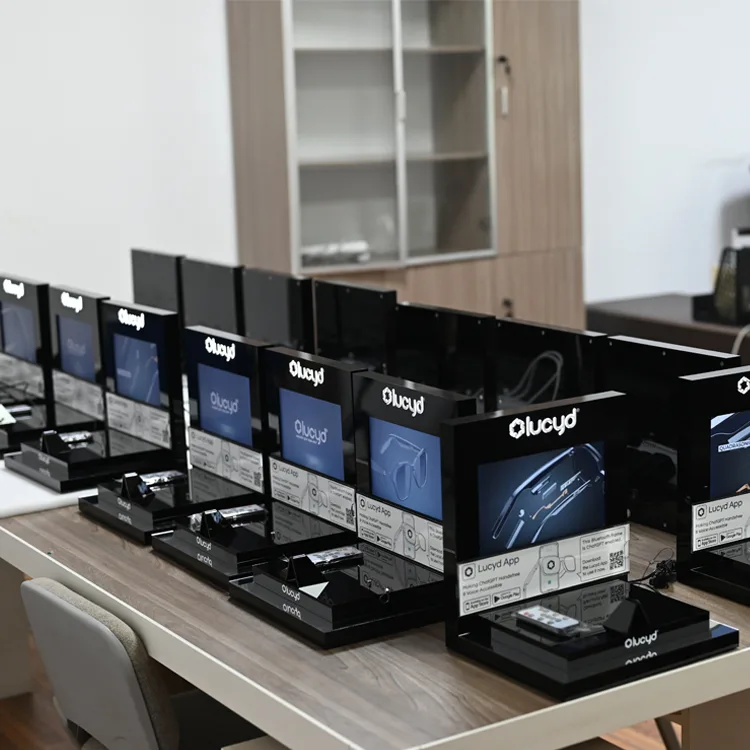
A 10.1-inch screen was incorporated into the fixture to continuously play branded product videos.
The screen system was separated from the audio demonstration system so that video and Bluetooth audio could be managed independently.
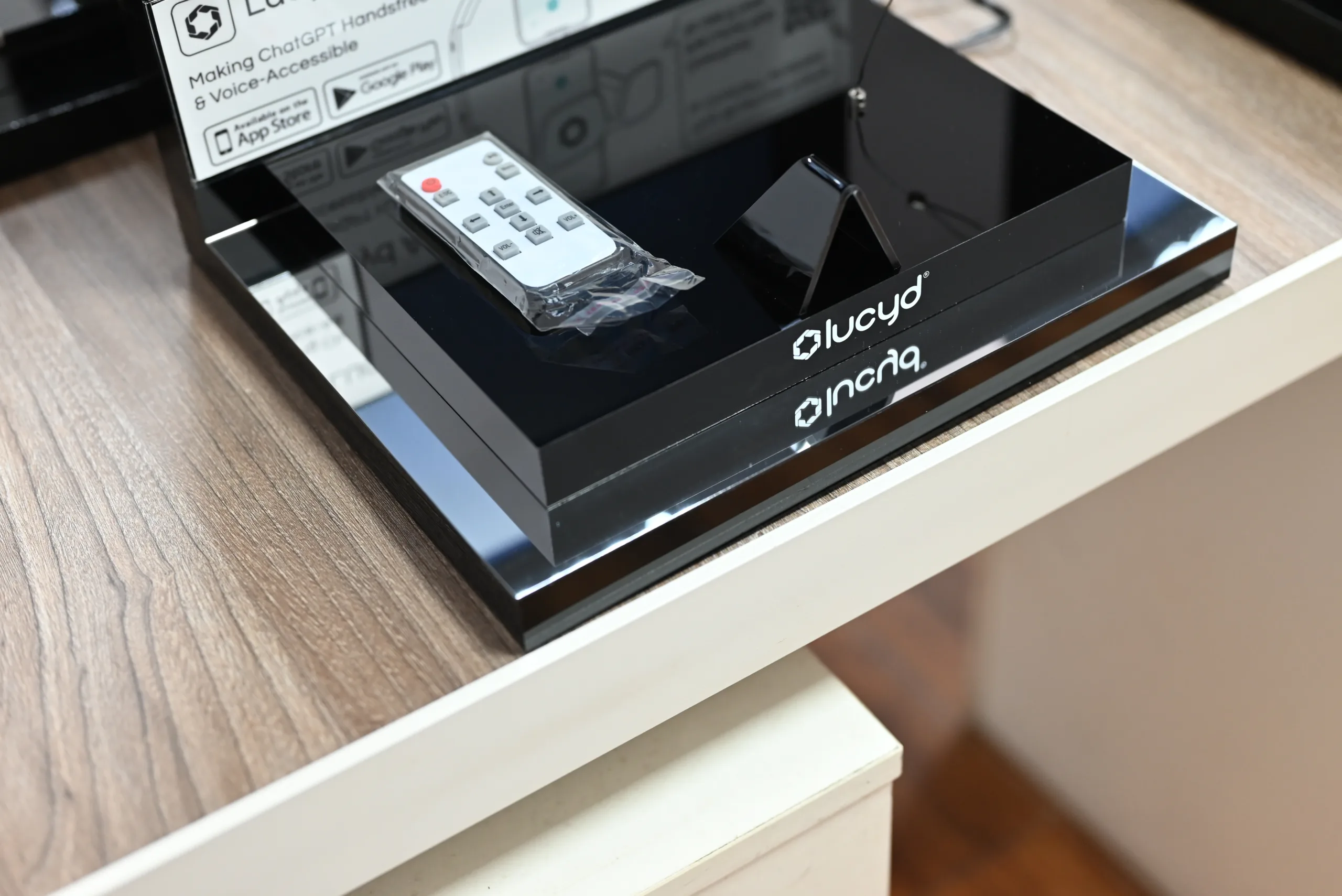
An independent Bluetooth MP3 module was integrated into the display.
Once paired, the eyewear could connect directly to the display’s audio system, allowing shoppers to experience the sound function of the smart glasses in-store.
Four physical controls were added for:
Play / Pause · Volume + · Volume – · Next Track
Rather than leaving charging cables exposed on the surface, APEX developed a recessed charging area compatible with the client’s standard charging cable.
The cable was secured inside the recess so that the charging point remained functional while the wiring stayed largely hidden.
Security cables were incorporated into the display while maintaining enough movement for customers to pick up and try the eyewear.
For multi-tier models, the security cable routing was concealed inside the fixture so that the mechanism was not visible from the rear.
The display used illuminated brand logos to strengthen shelf visibility.
Additional attention was given to the bonding of the logo letters so that the components would remain secure during international transportation and daily retail use.
Development & Production
The project followed a controlled development process:
Client Concept → Engineering Drawing → Drawing Approval → Prototype → Functional Testing → Sample Approval → Mass Production
The display platform had already gone through several generations of development.
Earlier versions focused on illuminated acrylic structures, video playback and security cables. Later models introduced different brand colors and multi-tier configurations.
The next stage incorporated freestanding fixtures and hidden anti-theft systems.
By 2025–2026, the display had developed into a more complete interactive platform integrating:
video + independent Bluetooth audio + charging + security + illuminated branding.
Before production, APEX produced prototypes to verify the electronics, Bluetooth connection, charging position, screen operation and product interaction.
After the updated sample was approved, the project moved into a 300-piece production order.
Results / Outcome
The final production batch included 300 customized smart-eyewear display units.
The completed displays successfully combined merchandising and product demonstration functions within one compact retail fixture.
The client specifically recognized the finished product for its:
solid construction, controlled details and reliable functional performance.
More importantly, the display allowed customers to interact with smart eyewear without requiring store staff to separately demonstrate every product function.
The project also created a reusable display platform that could be adapted for different branded eyewear programs through changes in color, graphics, logo and merchandising configuration.
Project Highlights
Project Information | Details |
Client Type | U.S. Smart Eyewear Brand Operator |
Main Market | United States |
Retail Scale | Approx. 300 retail locations |
End Brands | Lucyd / Nautica / Eddie Bauer |
Product | Interactive Smart Eyewear Display |
Final Order | 300 pcs |
Main Material | Acrylic + Electronic Components |
Display Screen | 10.1-inch |
Key Functions | Video / Bluetooth Audio / Charging / Anti-Theft / LED Logo |
Brand Color Control | Custom PMS color matching |
MOQ | 300 pcs |
Typical Lead Time | Approx. 30 days |
Development Model | Drawing → Prototype → Testing → Production |