How can consumers experience a smart home scenario in which opening a smart door lock automatically activates indoor lighting, air conditioning, and curtains—all within a limited retail display space?
For smart home brands, traditional static display stands can showcase the appearance of smart locks, control panels, and other connected devices. However, they often fail to demonstrate how these products work together as an integrated smart home system.
The client in this project is a technology brand specializing in smart home systems and smart door lock solutions. Its product portfolio includes smart door locks, intelligent control panels, smart lighting, and home automation devices.
To help consumers and distribution partners better understand the real-world experience of whole-home automation, the client wanted to develop a customized smart home experience display that could replicate real smart door lock installation and operation at a 1:1 scale while demonstrating automated interactions between connected home devices.
The display needed to recreate a realistic home entry experience: when a visitor unlocks the smart door lock and opens the door, the demonstration system presents coordinated responses, such as indoor lights turning on, air conditioning activating, and curtains opening automatically.
This requirement transformed the display from a conventional product merchandising fixture into an integrated interactive demonstration system combining mechanical structures, electrical controls, smart device installation, and simulated residential environments.
To address these requirements, APEX focused on realistic door lock installation, multi-device integration, automated scenario demonstrations, and space-efficient structural design, exploring how a compact retail fixture could recreate an authentic smart home entry experience.
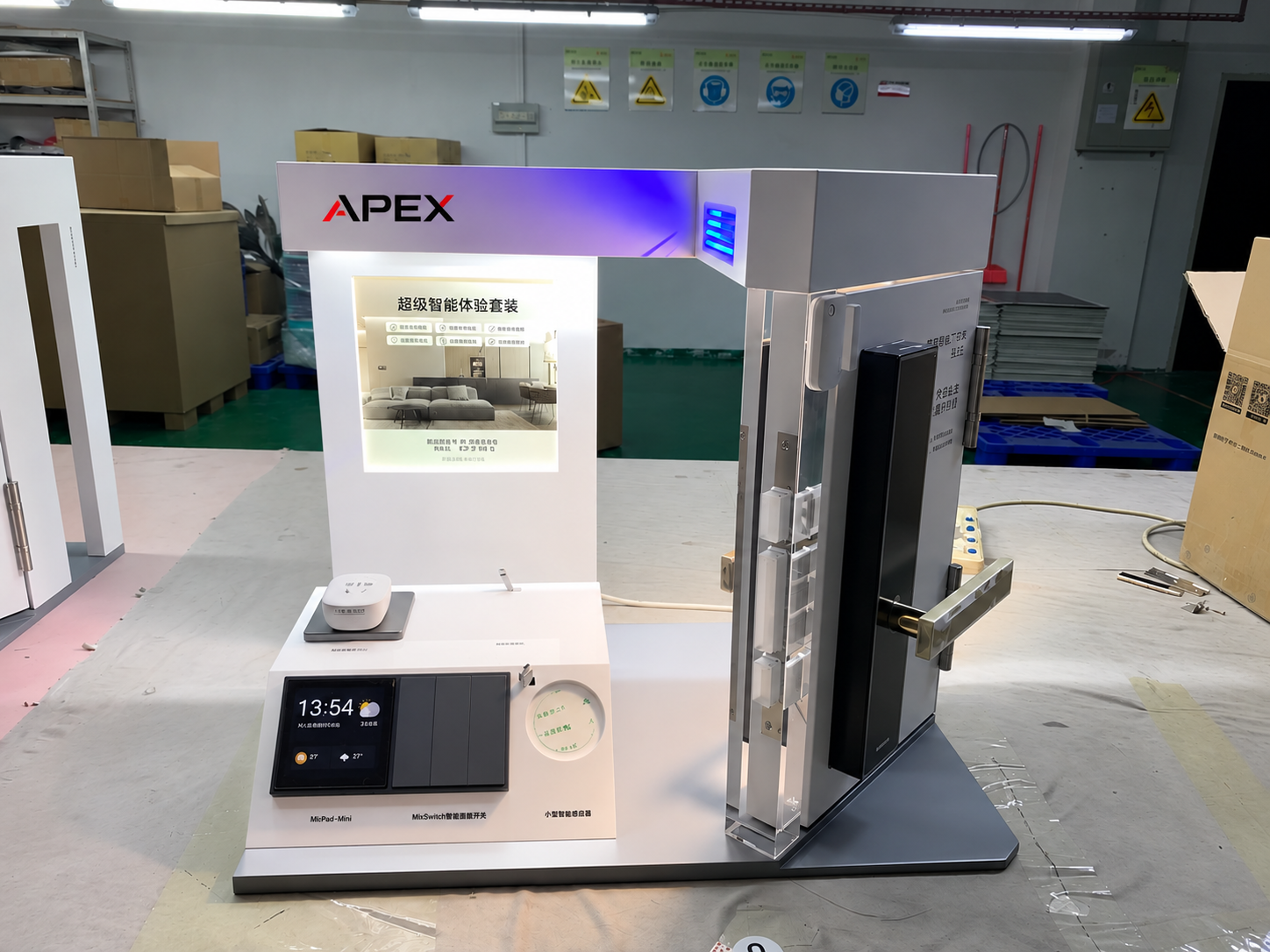
The client is a technology brand specializing in smart home and residential automation solutions. Its product portfolio includes smart door locks, intelligent control panels, smart lighting, and home automation control devices.
Unlike conventional home hardware or standalone electronic products, the competitive value of smart home technology lies not only in individual device functions but also in the ability of multiple devices to work together through automated control systems.
For example, in a connected home, unlocking and opening the front door can trigger a predefined welcome-home scene, automatically turning on the lights, activating the air conditioning, and opening the curtains.
Through centralized automation, several independent household devices can work together to create a seamless home entry experience.
However, these functions can be difficult to communicate through traditional retail displays.
When consumers only see smart locks, control panels, and other devices mounted on a display board, they may struggle to understand how these products interact in a real residential environment.
The client therefore wanted to move beyond conventional individual product displays and adopt a more interactive, scenario-based presentation.
By integrating a realistic smart door lock installation with a simulated indoor environment, the display would allow visitors to experience the relationship between a smart door lock and a whole-home automation system through a single door-opening interaction.
The client did not simply need a smart door lock display stand. It needed a miniature home entry experience that could turn complex smart home automation into something customers could see, operate, and understand.
The primary objective of this project was to transform a real residential smart entry scenario into an interactive demonstration fixture suitable for retail stores, showrooms, and product experience areas.
The client wanted visitors to operate a smart door lock installed in a realistic configuration, physically open the door, and observe coordinated feedback through lighting, simulated room elements, and connected smart devices.
Unlike a full-scale room installation, the display needed to concentrate the essential experience within a compact footprint.
The main requirements included the following.
The display needed to reproduce realistic door lock mounting conditions and operating methods.
Visitors should be able to interact with the smart lock and physically open the door, rather than simply viewing a product attached to a static display board.
The door-opening action needed to be connected to a smart home scenario demonstration.
This would help visitors understand how a smart door lock can serve as a trigger for home automation routines involving lighting, air conditioning, and curtains.
In addition to the smart door lock, the display needed dedicated mounting and presentation areas for intelligent control panels, smart home hubs, and other supporting devices.
This would allow visitors to understand the roles of different products within the broader smart home ecosystem.
The fixture needed to preserve essential door operation and automation demonstrations while maintaining a manageable overall size.
This would make it more suitable for retail stores, product experience areas, and showrooms.
Unlike static product stands, an interactive smart door lock display must accommodate frequent door opening, closing, and device operation.
Its structural stability, component mounting, and maintenance accessibility therefore require special consideration.
One of the defining features of this project is the integration of a functional smart door lock with a physically operable door.
Conventional retail display fixtures primarily support and present products. In contrast, a smart door lock experience display must also accommodate actual mechanical movement.
The lock mounting position, door thickness, frame clearance, hinge alignment, and relationship between the latch bolt and strike plate all influence the user experience.
Insufficient installation accuracy may lead to misalignment between the lock and door frame, friction during opening and closing, or inconsistent door operation.
Furthermore, when visitors repeatedly open and close the door, the hinges and connecting structures experience continuous mechanical loads.
Because the display is not supported by a permanent building wall and entrance door assembly, the forces generated during operation must be carried by the fixture’s own frame and base.
This makes the structural design significantly more demanding than that of a conventional static display stand.
Key Manufacturing Challenge: How can a compact retail display reproduce realistic smart door lock installation while ensuring smooth door operation and overall structural stability?
The client wanted consumers to experience the feeling of entering a smart home through a realistic door-opening interaction.
However, most retail environments cannot accommodate a complete residential room for every product demonstration.
The display therefore needed to condense a complex home environment into a compact simulated space.
From a structural perspective, the fixture had to accommodate not only a door but also an interior scene backdrop, lighting areas, product display sections, and smart control devices.
These functional zones needed to maintain clear visual relationships.
If the door occupied too much space, it could restrict the remaining product display areas.
If too many devices were concentrated in one section, the display could become visually cluttered, making it difficult for visitors to identify the main automation features.
The simulated interior also required appropriate visual depth and lighting effects to make changes in the home environment noticeable after the door was opened.
Key Manufacturing Challenge: How can a compact display accurately communicate a realistic smart home entry scenario without sacrificing essential product presentation and interactive functions?
Another major difference between an interactive smart home display and a conventional fixture is the need to generate functional feedback through physical interaction.
The intended demonstration sequence was:
Smart Door Lock Unlocks → Door Opens → Welcome-Home Scene Is Triggered → Lighting, Air Conditioning, and Curtains Respond
To recreate this experience, the smart lock’s operating status, the door-opening action, and the scenario demonstration system needed to work together.
Within a limited display space, actual smart devices, control modules, lighting components, and simulated environmental elements had to be integrated into one coordinated fixture.
Different components may require different power supplies, communication interfaces, and installation conditions.
If the automation logic is poorly designed, the display may experience delayed responses, inconsistent activation of connected functions, or unreliable repeated demonstrations.
Therefore, the manufacturing challenge extends beyond ensuring that individual electrical devices operate correctly.
It also involves coordinating the triggering relationships and control logic between different systems.
Key Manufacturing Challenge: How can multiple smart devices and demonstration functions be integrated into a single system so that opening the door reliably initiates the intended automation sequence?
The display integrates a smart door lock, control panels, lighting components, product presentation areas, and simulated room structures.
These functions require electrical power, control wiring, and sufficient installation space.
However, to maintain a clean and professional retail appearance, wiring and electrical components should remain largely concealed from customers.
The operable door structure adds another layer of complexity.
Where cables need to pass through or near moving components, the design must account for bending clearance and mechanical protection to prevent pinching, pulling, or excessive strain during door operation.
Electrical components also require suitable access for installation, troubleshooting, and maintenance.
Key Manufacturing Challenge: How can multiple devices, concealed wiring, and an operable door structure be accommodated within a compact fixture while maintaining a clean exterior appearance?
Visitors generally observe products on conventional static display stands without applying significant mechanical forces to the fixtures.
An interactive smart door lock display is different.
Users physically operate the lock, push or pull the door, and observe the resulting automation response.
These actions introduce repeated dynamic loads into the structure.
Without adequate support between the base and door frame, the fixture may experience movement, instability, or loosening of connecting components over time.
When the door is opened, the resulting forces can also affect the display’s weight distribution and overall stability.
The engineering design must therefore consider door weight, opening range, hinge connections, and base support.
Key Manufacturing Challenge: How can the display maintain structural stability during repeated door operations without compromising the authenticity of the user experience?
To address the client’s scenario-based demonstration requirements, APEX approached the project through integrated mechanical design, space planning, multi-device installation, and electrical system coordination.
Unlike conventional retail display fixtures, which are mainly designed around product placement, this type of project requires mechanical operation, smart controls, and visual presentation to function as an interconnected system.
To achieve a realistic smart door lock demonstration, APEX incorporated an operable simulated door and frame into the display fixture.
This allowed the smart lock to be installed in a configuration closely resembling its use on an actual residential entrance door.
During engineering development, the lock mounting area needed to accommodate the physical dimensions of the specified smart lock.
The relationships between the door panel, lock body, hinges, and strike plate also required careful coordination.
Appropriate clearances between the door and frame were necessary to provide sufficient space for lock operation and door movement.
Compared with simply mounting a smart lock on a display board, this configuration allows visitors to experience the actual unlocking and door-opening process.
Structural planning also needed to consider how the door frame connects to the base so that the fixture could withstand the forces generated during repeated operation.
The main value of this design is that it transforms a static product display into an interactive smart door lock demonstration with realistic physical operation.
To overcome the conflict between realistic residential scenarios and limited retail floor space, APEX organized the display into interconnected functional zones.
The fixture included the following main areas.
Smart Door Lock Interaction Zone
An operable door and realistic lock mounting structure allow visitors to experience a smart home entry operation.
Simulated Interior Environment
An interior backdrop, lighting effects, and decorative elements create a simplified representation of a connected home.
This helps visitors associate the demonstration with changes that would occur inside a real residence after entering.
Smart Device Display Zone
Dedicated presentation areas accommodate intelligent control panels, smart home hubs, and other supporting devices.
These allow visitors to examine individual products and understand their roles within the smart home system.
Product Information and Visual Presentation Zone
Product information graphics and display lighting help communicate the main functions of the connected home solution.
Base Support and Installation Structure
The display base and supporting framework connect the functional zones while providing installation space for the necessary internal components.
This zoned layout allows physical products and scenario-based demonstrations to be combined within a single display fixture without building a complete residential room.
The experience the client wanted to communicate was straightforward: opening the smart door lock causes multiple connected devices inside the home to respond.
Therefore, APEX’s display integration approach needed to focus on the relationship between physical door operation and automated scenario feedback.
The demonstration begins with a real door-opening action.
Once the smart lock has been unlocked and the door is opened, the demonstration system triggers the corresponding smart home scene according to the predefined control logic.
The lighting area illuminates, while air conditioning and curtain functions are represented through appropriate device responses or simulated scenario effects.
This approach brings together several actions that would normally occur throughout a real home and presents them through one compact entry demonstration.
From an engineering perspective, the triggering method must be selected based on the actual interfaces available on the smart lock and its control system.
The responses of different smart devices or demonstration modules must then be coordinated.
The key is to maintain a clear relationship between three stages:
Physical Interaction → Control Trigger → Scenario Feedback
By organizing the display around this sequence, visitors can understand not only the smart lock itself but also its role within a whole-home automation system.
To accommodate multiple connected devices, APEX needed to consider both the physical display structure and electrical installation requirements during the design stage.
The mechanical structure supports the door, secures the products, and defines the different demonstration zones.
The electrical system provides power and control connections for lighting and associated demonstration equipment.
These two systems must be coordinated during the design process rather than treating wiring as an afterthought once the cabinet has been fabricated.
Important structural and electrical integration considerations include:
Determining component mounting positions based on actual device dimensions to avoid spatial conflicts.
Planning concealed cable routing to minimize visible wiring.
Arranging cables near moving door components to prevent interference during opening and closing.
Positioning serviceable electrical components where they can be inspected or replaced.
Considering electrical safety, cable retention, and necessary ventilation according to equipment requirements.
This integrated design approach helps maintain consistency between the exterior presentation, internal structure, and electrical functionality while providing better conditions for assembly and maintenance.
To support repeated door demonstrations, APEX needed to evaluate the door support, frame connections, and base structure as one mechanical system.
From an engineering perspective, forces generated during door opening and closing are transferred through the hinges and door frame into the main support structure and ultimately the display base.
Therefore, the stability of the fixture cannot depend solely on the door frame.
The connection strength between the frame and base, along with the overall weight distribution, must also be considered.
During structural development, appropriate door movement clearance, connection methods, and base support can help reduce the risk of instability during repeated use.
At the same time, door supports and structural components should be integrated into the overall appearance as seamlessly as possible.
This helps preserve the modern, technology-focused visual presentation of the fixture.
The objective is to balance authentic physical interaction with the structural stability required for an interactive retail display.
A smart home experience display is more than a combination of mechanical and electrical components.
It is also an important element of a brand’s physical product presentation.
The fixture incorporates a main cabinet structure, a simulated door assembly, product mounting panels, transparent or decorative components, display lighting, and branded visual areas.
Different components have different requirements for load-bearing capacity, manufacturing accuracy, surface finishing, and installation methods.
APEX can coordinate multiple manufacturing processes—including metal fabrication, panel processing, acrylic fabrication, printing, and lighting integration—according to the project’s structural and functional requirements.
For components that carry forces generated by door operation, structural strength and installation accuracy are key considerations.
For customer-facing product display areas, visual cleanliness, surface finishes, and component alignment are particularly important.
For lighting and functional sections, illumination, internal installation space, and maintenance accessibility must also be coordinated.
This combination of multi-material manufacturing and cross-process integration supports the development of a unified physical display from a technically complex, multifunctional smart home demonstration concept.
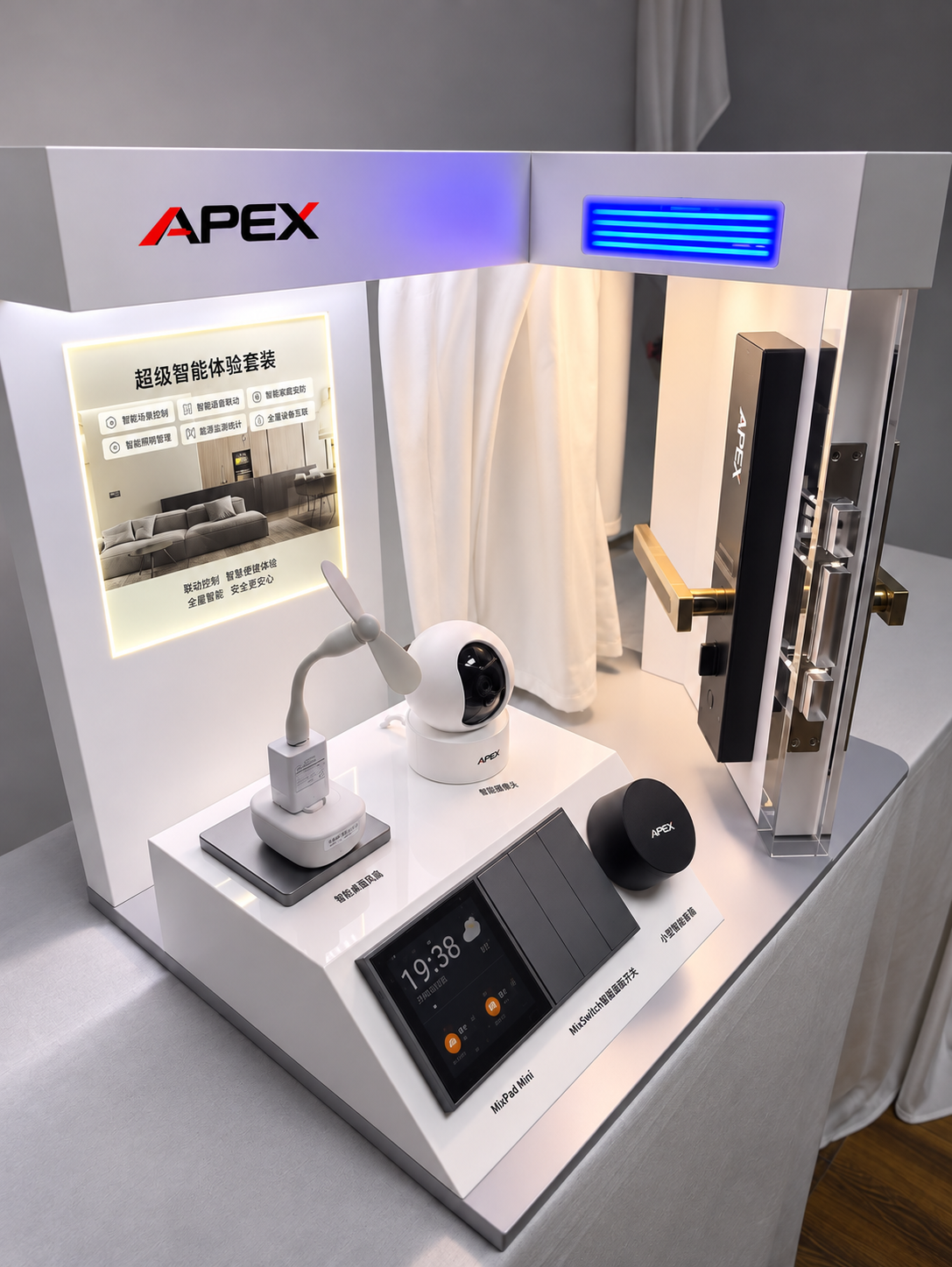
The basic principle of smart door lock integration with whole-home automation is to use a door lock status or door-opening event as a trigger for a predefined smart home scene.
The connected home control system then executes the corresponding automated actions.
In a real residential environment, users can link a smart door lock with intelligent lighting, air conditioning controls, and motorized curtain systems.
When the system detects an entry event that meets the predefined conditions, it can activate the associated automation routine.
A retail experience display follows a similar concept, although its implementation must be adapted to the fixture’s available space, actual equipment, and demonstration requirements.
The intended interaction sequence can be divided into four steps.
Step 1: The User Operates the Smart Door Lock
The visitor unlocks the smart door lock and opens the door installed on the display fixture.
Step 2: The Demonstration System Detects the Entry Action
Based on the selected device interface and triggering method, the control system identifies the relevant lock or door status.
Step 3: The Predefined Smart Home Scene Is Triggered
The system coordinates the required feedback for lighting, air conditioning, and curtain automation according to the demonstration settings.
Step 4: The Visitor Observes the Connected Responses
Through changes in display lighting, device status, and the simulated interior environment, visitors can understand how multiple connected home devices respond to an entry event.
It is important to note that air conditioning and curtain functions in a compact retail display can be represented through actual device control or simulated demonstration effects, depending on the project requirements.
Installing full-size residential air conditioning units or curtain systems is not always necessary.
For scenario-based retail demonstrations, the most important objective is to communicate the relationship between connected devices accurately and allow customers to understand the automation experience through physical interaction.
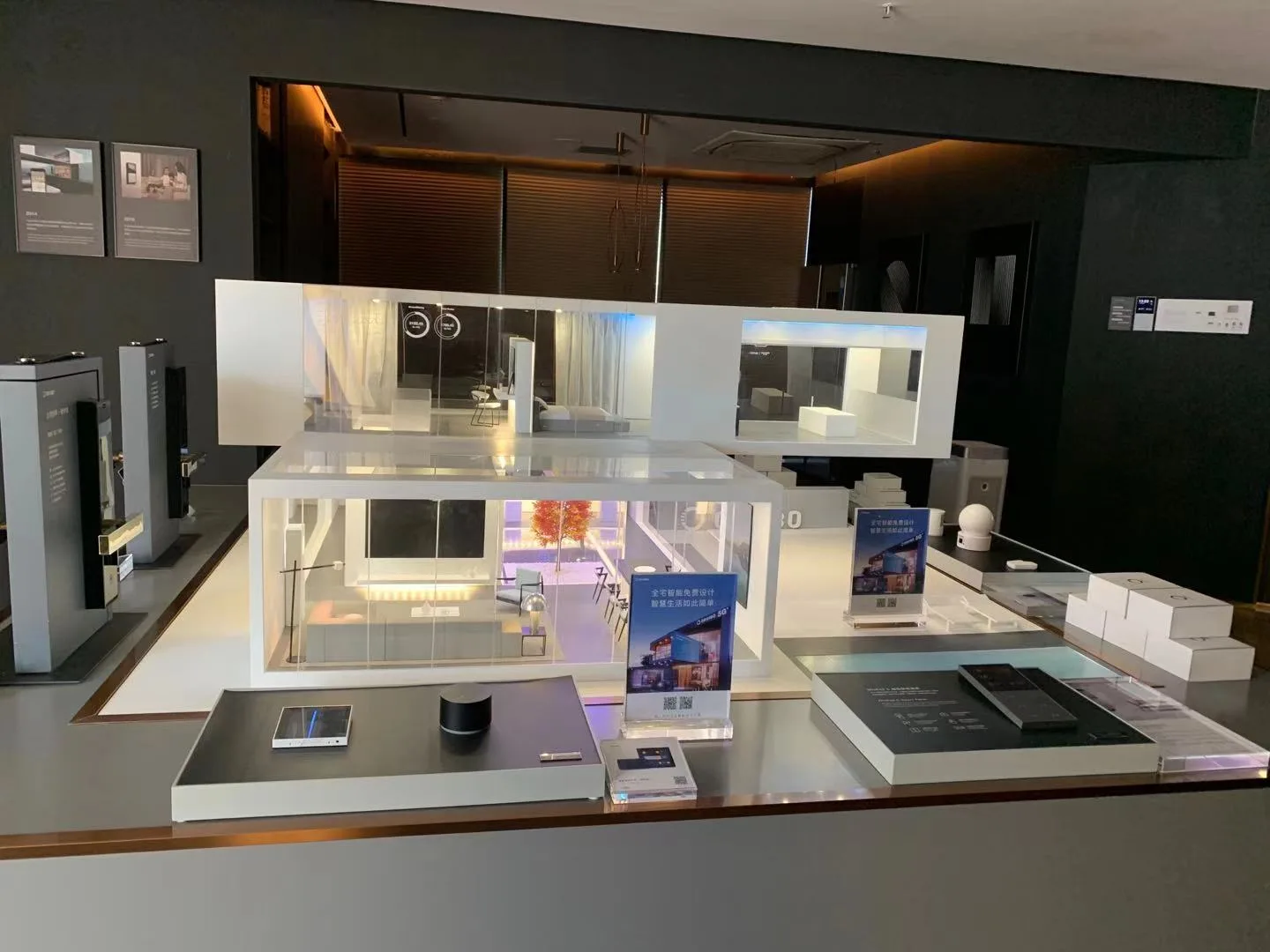
A conventional smart door lock display stand is generally designed for product mounting, visual presentation, and basic feature explanations.
An interactive smart home experience display must support physical operation, mechanical movement, automated scenario feedback, and multi-device integration.
The differences are significant.
| Comparison | Standard Smart Door Lock Display Stand | Interactive Smart Home Experience Display |
|---|---|---|
| Primary Function | Product presentation and information | Physical interaction and automated scenario demonstration |
| Door Lock Installation | Mainly fixed product mounting | Realistic door lock installation |
| Door Structure | May not include a movable door | Supports actual door opening and closing |
| Smart Home Automation | Usually explained through graphics or text | Can demonstrate connected device responses after door opening |
| Internal Design | Product mounting and basic wiring | Integration of multiple devices, control wiring, and mechanical structures |
| Structural Requirements | Primarily static load support | Both static support and dynamic operation |
| Manufacturing Complexity | Relatively low | Requires mechanical, electrical, and scenario demonstration integration |
For retail applications focused only on presenting the appearance of a smart door lock, a standard display stand may be sufficient.
However, when a brand wants customers to understand how a smart lock interacts with other home devices, the display must be developed as a complete interactive experience system.
An interactive smart home experience display is a retail fixture that combines physical products, simulated environments, and interactive demonstrations.
It allows consumers to operate smart door locks, control panels, or other connected devices and observe how different smart home products can work together through automated scenarios.
Yes. With appropriate device integration and demonstration control systems, a smart door lock display can simulate these automated functions.
The fixture can use a door lock operation or door-opening event as the trigger and present lighting, air conditioning, and curtain responses through actual connected devices or simulated feedback.
The specific implementation depends on device interfaces, communication protocols, and demonstration requirements.
An interactive smart door lock display involves actual door movement.
The frame, hinges, lock mounting positions, and base support must work together to ensure smooth operation and structural stability.
This makes it more mechanically demanding than a conventional static product display stand.
A compact, scenario-based layout can combine a functional smart door lock, simulated interior environment, smart device presentation areas, and lighting feedback within one fixture.
By preserving the essential physical interactions and automation responses, the display can communicate the basic logic of a smart home system without requiring a full-scale residential room.
The main challenges include precise integration of smart locks with operable doors, multi-device mounting and wiring, control system integration, automation demonstrations, structural stability, and space-efficient functional layouts.
These projects therefore require coordinated mechanical engineering, product installation, electrical integration, and retail display design.
APEX provides custom retail display structure design, multi-material manufacturing, and equipment installation integration based on customer product specifications, demonstration objectives, and functional requirements.
For smart door locks, intelligent control panels, and whole-home automation displays, APEX can support the development of suitable fixtures by evaluating structural manufacturability, device mounting, space planning, and electrical integration.
Specific automation functions must be evaluated according to the client’s smart device interfaces and technical requirements.
For smart home brands, the value of retail display fixtures is no longer limited to presenting individual products.
Helping consumers understand how different connected devices work together through simple, intuitive interactions is becoming an important consideration in scenario-based retail display design.
What makes this project distinctive is the client’s intention to recreate a realistic smart home entry experience within a compact display fixture.
From smart door lock installation and operable door structures to lighting, air conditioning, and curtain automation demonstrations, the entire fixture must bring together mechanical operation, device integration, and scenario presentation.
These requirements distinguish it from conventional retail display stands and place greater demands on the manufacturer’s structural engineering and functional integration capabilities.
APEX approached the project by considering the client’s actual demonstration requirements and coordinating mechanical structures, scenario-based layouts, multi-material manufacturing, and electrical integration.
The central engineering objective was to address the manufacturing challenges involved in combining realistic door operation with smart home automation demonstrations.
An effective smart home retail display should do more than show consumers what a product looks like. It should help them experience how connected technology can improve everyday living.
Are you looking to demonstrate the interaction between smart door locks and whole-home automation systems in retail stores, showrooms, or product experience areas?
APEX provides custom retail display solutions tailored to the characteristics of smart door locks, intelligent control panels, smart lighting, and other connected home devices.
From structural design and multi-material manufacturing to equipment installation and functional integration, we help brands turn complex product demonstration requirements into practical, engaging physical display solutions.
Contact APEX to discuss your smart home products and demonstration requirements, and explore a customized interactive retail display solution for your brand.