From Original Design and Multi-Material Engineering to Custom Tooling and Mass Production
Can APEX Manufacture Retail Displays Completely From Scratch?
Yes. APEX is a China-based custom retail display manufacturer that develops and manufactures display fixtures according to customer requirements—not just existing product templates.
Our capabilities cover original design, structural engineering, multi-material manufacturing, custom mold and tooling development, prototyping, surface finishing, assembly, and mass production.
Whether a customer provides a sketch, a 3D rendering, a physical sample, or detailed engineering drawings, APEX can help transform the concept into a practical, manufacturable retail display.
Unlike customization limited to changing the size, color, or logo of an existing fixture, our approach allows brands to develop new structures, specialized components, and functional display systems suited to their products and retail environments.
At APEX, customization starts with your requirements, not our product catalog.
1. What Makes APEX Different From a Standard Display Supplier?
Many display suppliers specialize in a limited selection of products or manufacturing materials.
For straightforward orders, this approach may be sufficient. However, complex retail projects often require several manufacturing processes and materials to work together.
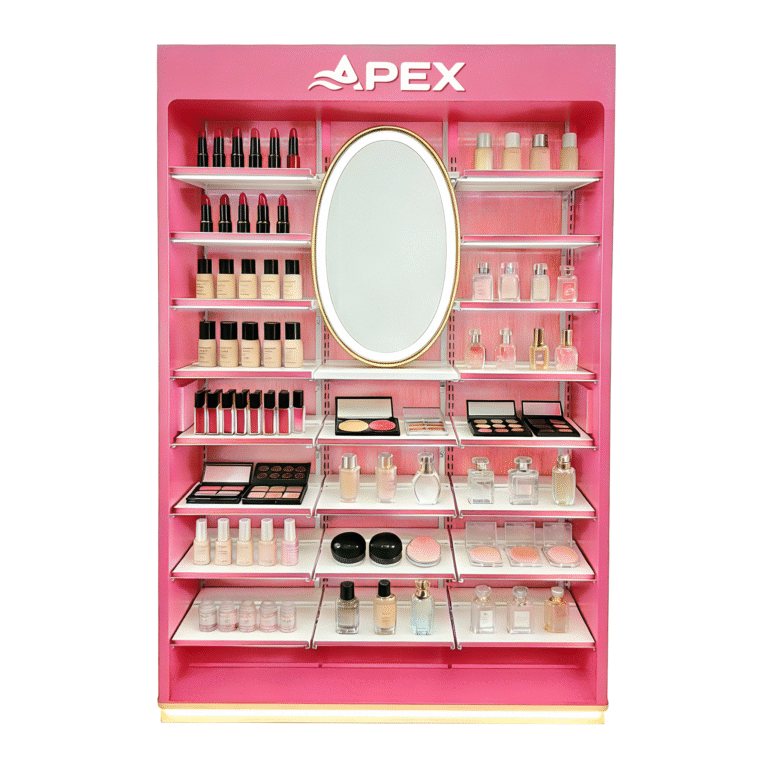
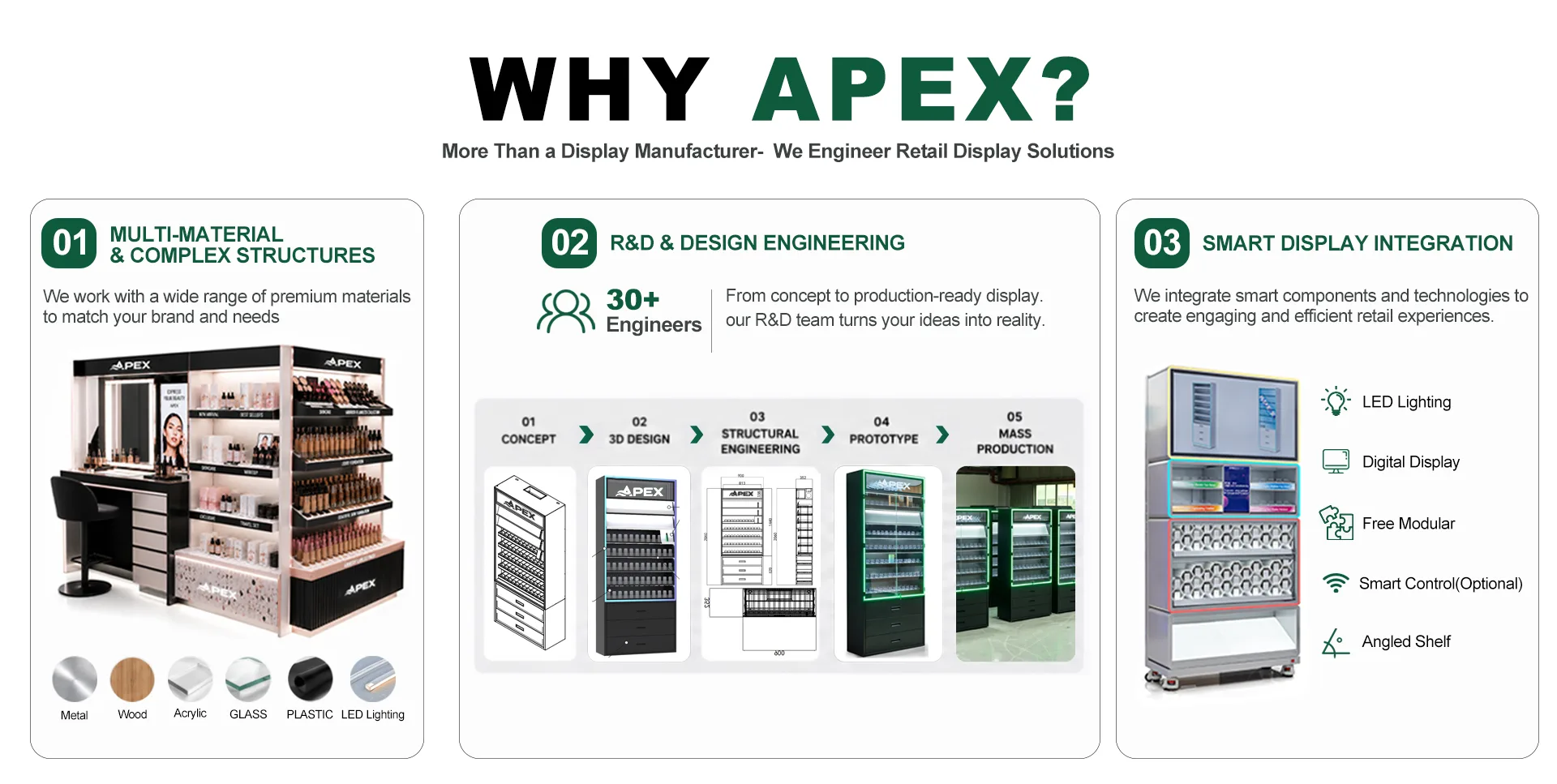
A single display cabinet may involve a metal framework, precision-cut acrylic trays, wooden panels, plastic components, branded graphics, and integrated lighting.
Producing these elements separately is only part of the challenge. They must also fit together accurately, maintain a consistent appearance, and function as one complete display system.
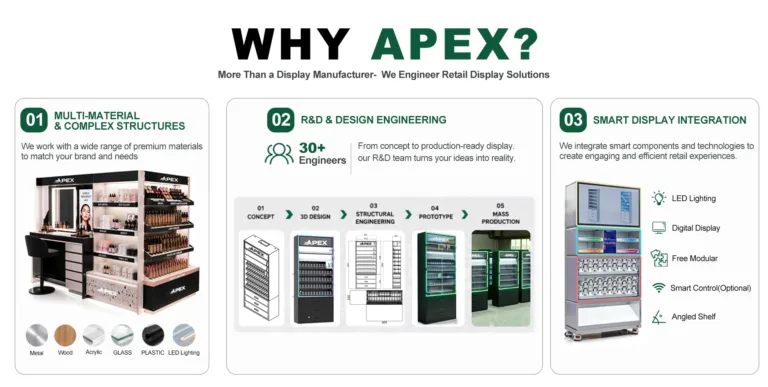
APEX combines product development with multi-material manufacturing and coordinated production processes to address these requirements.
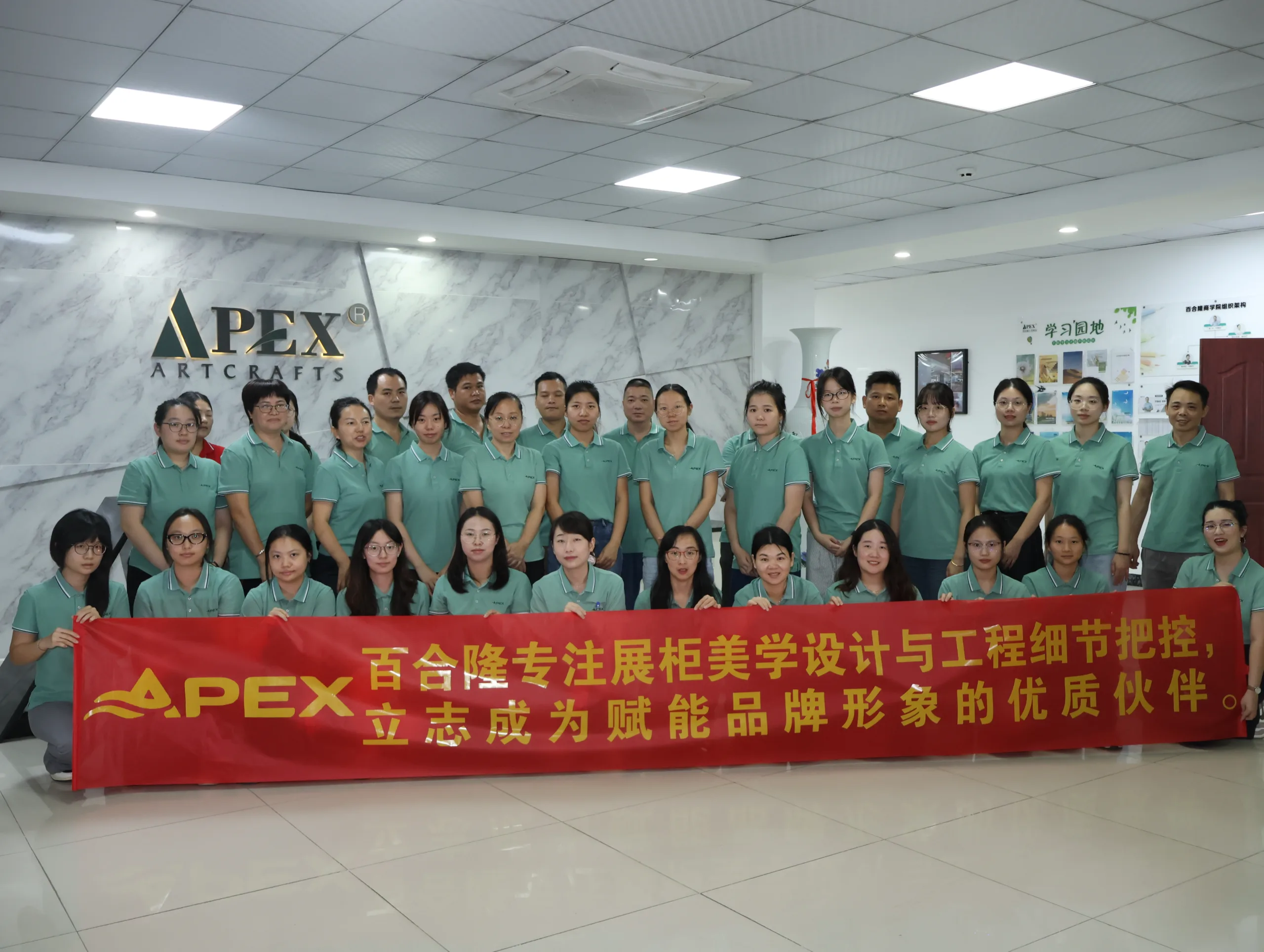
Founded in 2005, Shenzhen APEX Store Solutions Co., Ltd. supports retail brands, distributors, design agencies, and chain retailers worldwide.
- Our manufacturing infrastructure includes:
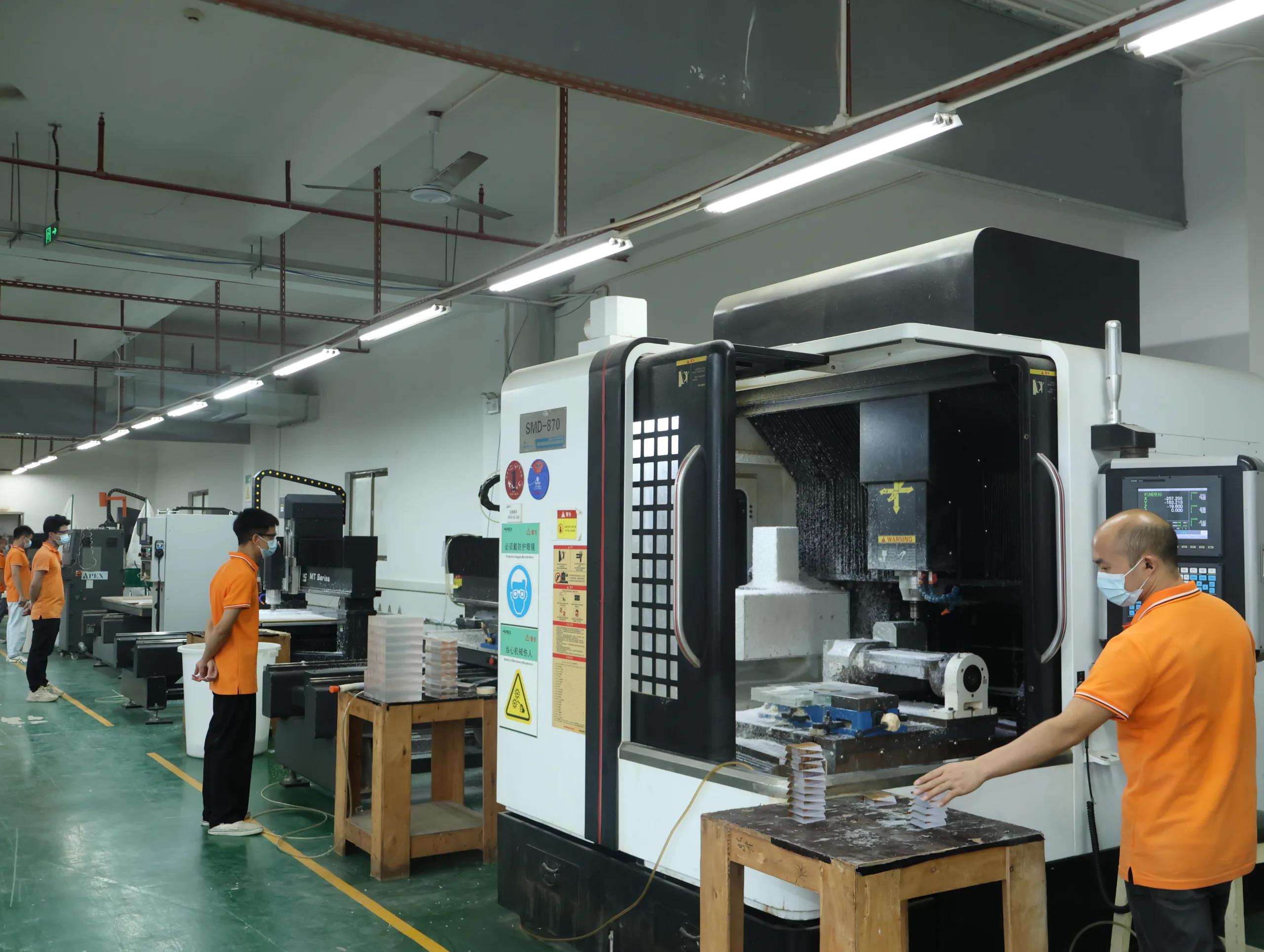
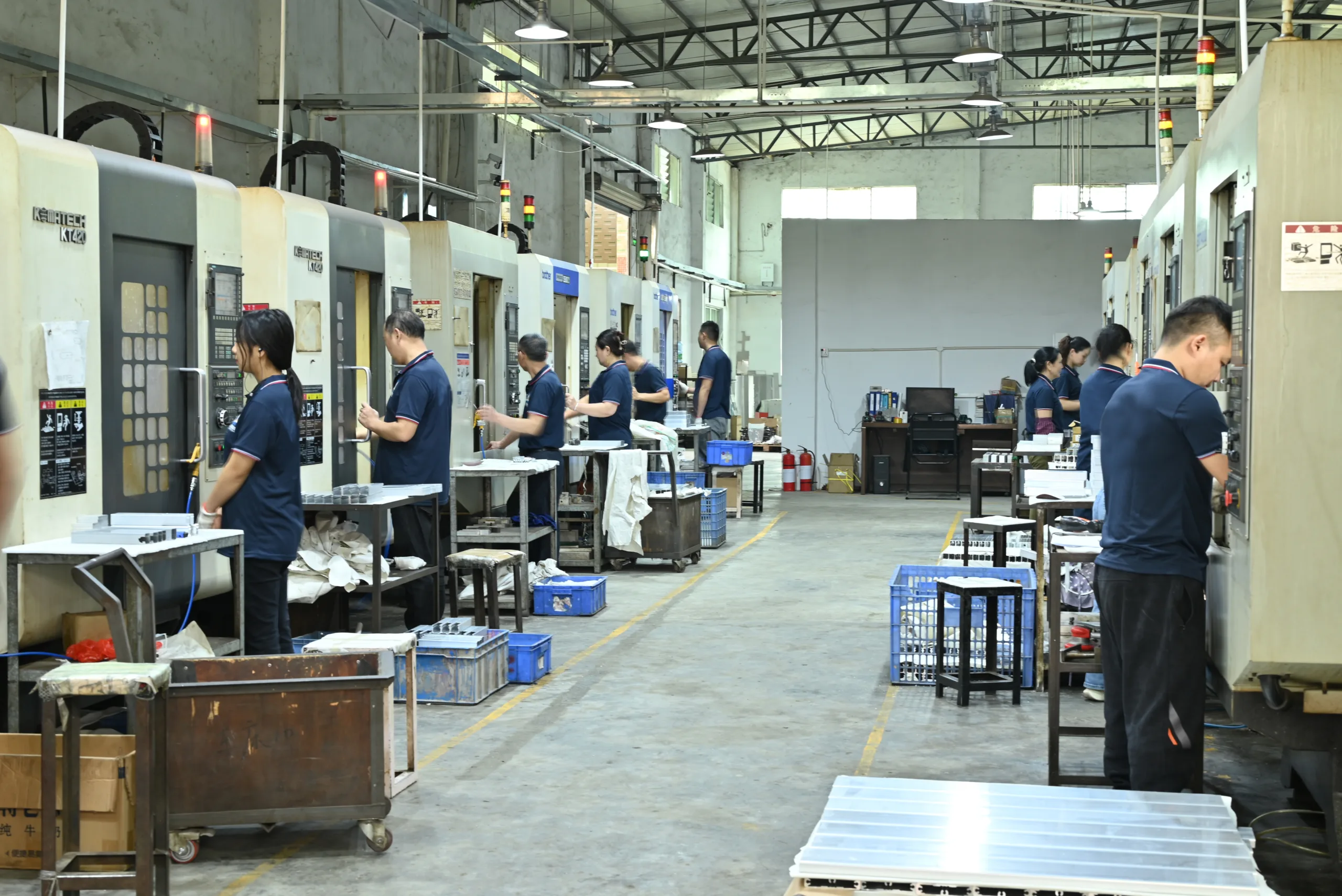
- Over 25,000 square meters of production space across Shenzhen and Huizhou
- More than 200 employees
- Over 200 manufacturing machines and pieces of equipment
- Manufacturing capabilities covering acrylic, metal, plastic, wood, and cardboard
- Integrated production services from product development to finished assembly
This manufacturing foundation enables APEX to support both highly customized individual projects and repeat production programs.
2. Multi-Material Manufacturing: One of APEX’s Core Strengths
Why does multi-material manufacturing matter for custom retail displays?
Different materials provide different structural, functional, and visual advantages. Combining them allows a display to be engineered around actual product requirements rather than the limitations of a single material.
Metal Fabrication — Structural Strength and Stability
Metal is commonly used for supporting frames, shelving systems, brackets, bases, and load-bearing components.
Depending on the project, APEX can work with steel, stainless steel, aluminum, and other suitable metal materials.
Metal fabrication is particularly important for floor-standing displays, double-sided retail gondolas, modular shelving, and other fixtures requiring structural stability.
Acrylic Manufacturing — Product Visibility and Precision
Acrylic is widely used for premium display trays, transparent covers, product holders, branded panels, and protective components.
Its transparency, forming flexibility, and surface finishing options make it suitable for cosmetics, jewelry, electronics, and other retail categories.
Custom acrylic components can be developed to accommodate specific product shapes, packaging dimensions, and presentation requirements.
Wood and Engineered Wood — Premium Retail Presentation
Wood and engineered wood materials are often selected for cabinets, decorative surfaces, storage units, and premium retail environments.
Wooden elements can be combined with metal frameworks, acrylic product holders, and lighting to create displays that balance visual appeal with practical merchandising functions.
Plastic Components — Custom Shapes and Specialized Functions
Plastic manufacturing allows specialized housings, product holders, structural accessories, and other components to be developed for specific applications.
When standard parts are unsuitable, injection molding or other forming processes may be evaluated to achieve the required shape and manufacturing consistency.
Additional Materials and Integrated Features
Depending on project requirements, APEX can also coordinate the use of tempered glass, PVC, cardboard, resin, branded graphics, LED systems, and electronic components.
For example, a premium retail showcase might combine:
Metal framework + MDF cabinet + acrylic product holders + tempered glass + integrated LED lighting.
The value of multi-material manufacturing is not simply having access to different materials.
It is the ability to select, engineer, process, and integrate them into a display that meets the customer’s functional and visual requirements.
3. Integrated Manufacturing Processes: From Individual Components to Finished Displays
Multi-material manufacturing requires coordination between different production technologies.
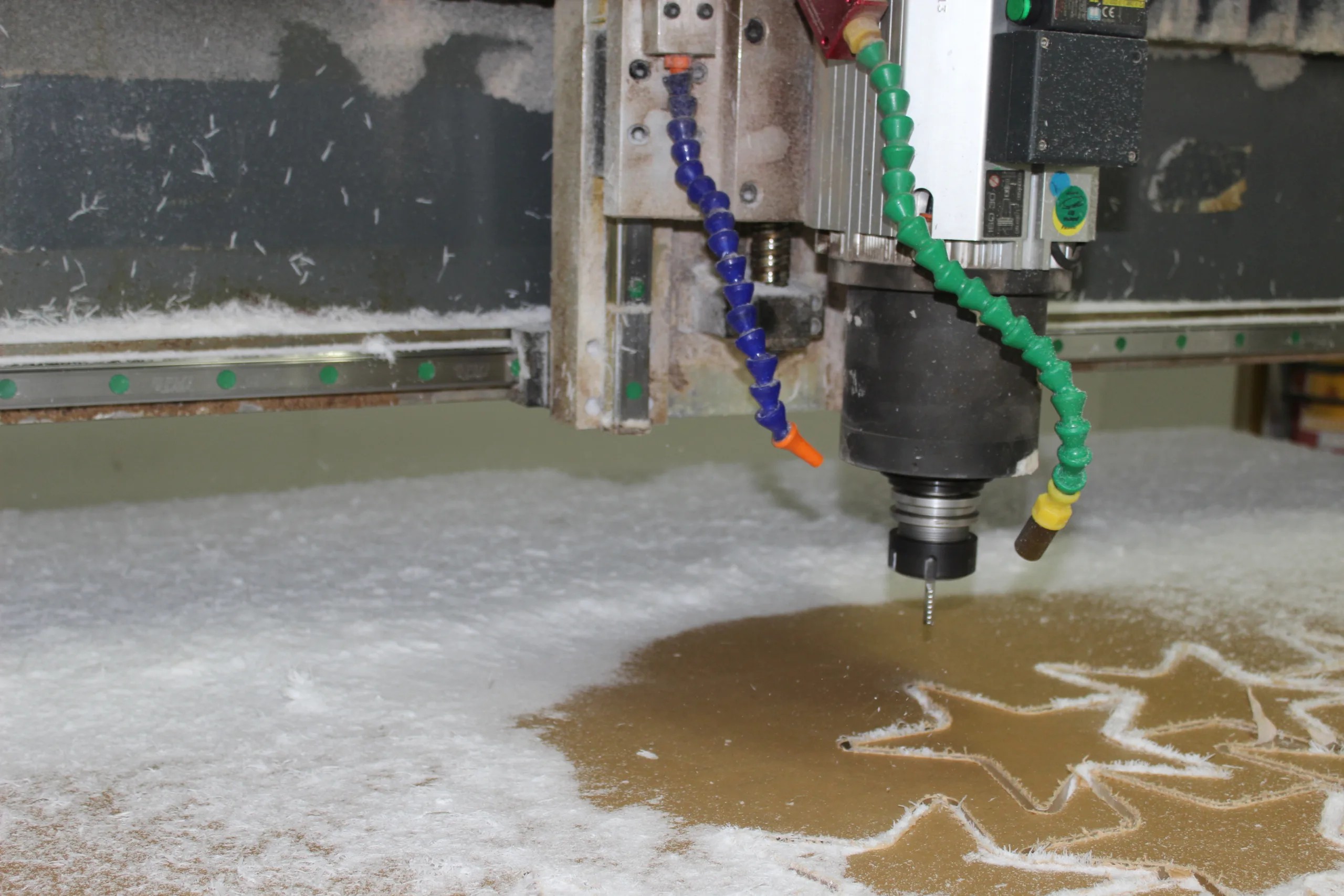
APEX’s manufacturing and finishing capabilities include CNC machining, laser cutting, acrylic processing, forming, UV printing, electroplating, hot stamping, and other applicable surface finishing methods.
These processes support different aspects of product development.
Precision Processing
Components are manufactured to the required geometry and dimensions so that materials with different characteristics can be assembled into a complete structure.
Surface Finishing and Brand Presentation
Finishes such as powder coating, printing, polishing, and decorative treatments help achieve the visual requirements of different brands and retail environments.
Functional Integration
Lighting, product pushers, adjustable shelves, security mechanisms, drawers, electronic screens, and other features can be incorporated into a display where required.
Assembly and Production Coordination
A finished retail display must bring together structural parts, decorative components, product holders, electronics, and other elements with consistent fit and appearance.
For overseas brands, coordinated manufacturing reduces the need to independently manage multiple component suppliers and assembly processes.
4. Can APEX Develop New Molds Instead of Using Standard Components?
Yes. APEX supports custom mold and tooling development for display projects requiring unique components or structures that cannot be achieved with standard solutions.
Custom tooling may be appropriate for specialized product holders, plastic housings, unique structural details, and other components requiring a dedicated manufacturing method.
However, not every fully customized display needs a new mold.
Some original designs are better manufactured through metal fabrication, acrylic processing, CNC machining, or combinations of these methods.
Our engineering approach is to evaluate the intended design, materials, quantity, cost, and manufacturing feasibility before recommending a suitable production method.
The objective is not to use a new mold for every project. It is to manufacture the display the customer actually needs.
5. Real APEX Projects: How Our Manufacturing Capabilities Work in Practice
Case Study 1: CRISLU — Multi-Material Jewelry Display Development
Industry: Jewelry and Fashion Accessories
Market: United States
Key Capabilities: Multi-Material Manufacturing, Structural Engineering, Premium Finishing, Small-Batch Production
APEX has worked on customized jewelry display projects for CRISLU, a U.S. jewelry brand with different branded retail programs.
Unlike standard display orders, these projects often begin with an initial sketch, visual reference, or design concept.
The challenge is to preserve the customer’s intended appearance while developing a structure that can be manufactured and assembled reliably.
Depending on the specific project, APEX’s solutions have combined acrylic, metal, PVC, MDF, tempered glass, and lighting.
The development work has included rotating mechanisms, lockable display units, concealed wiring, custom branded graphics, and specialized product holders.
Representative orders in the project records include 20–50-unit production batches for different display formats.
What This Demonstrates
This collaboration shows how APEX can coordinate multiple materials and manufacturing methods for highly customized retail fixtures, even when order quantities are relatively small.
The value lies in transforming customer concepts into finished products without forcing every design into a standard display structure.
Read the CRISLU Case Study
Case Study 2: Luxury Beauty Retail Displays — Multi-Material Engineering for Global Rollouts
Industry: Beauty and Cosmetics
Project: International Retail Display System
Key Capabilities: OEM Manufacturing, Design Translation, Modular Engineering, Repeat Production
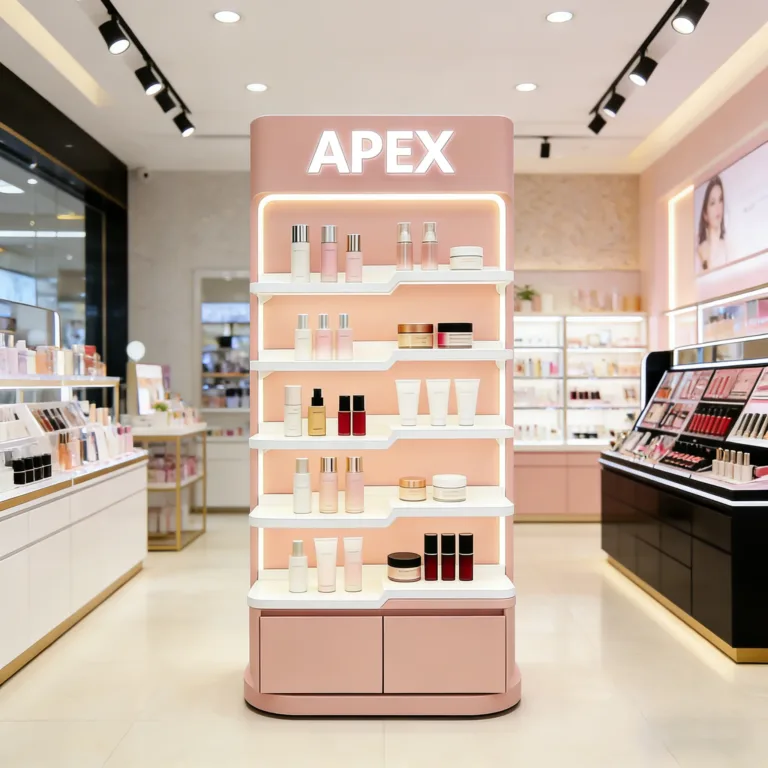
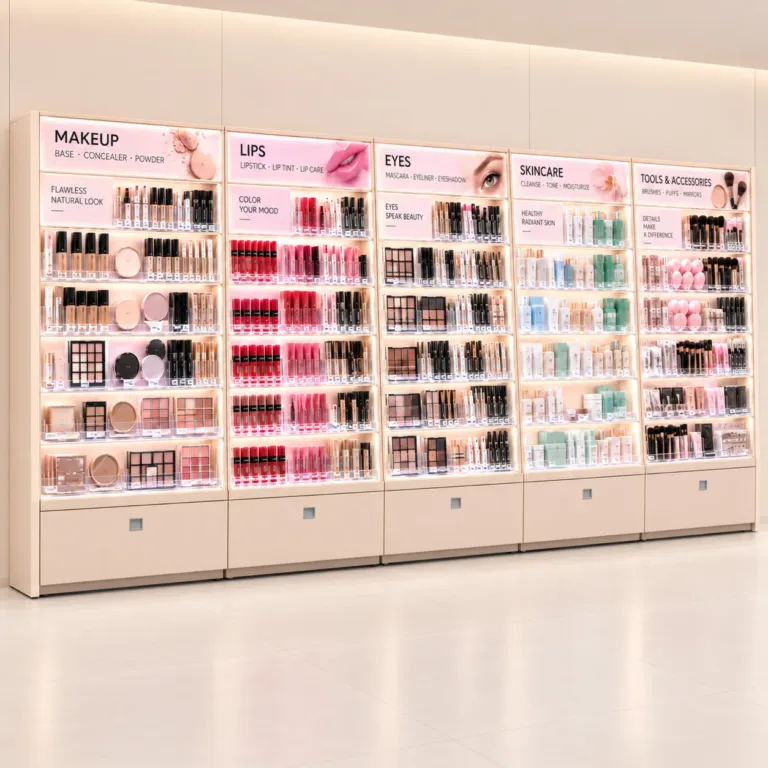
For an international retail display solutions provider, APEX supported the development and manufacturing of premium beauty display systems intended for multiple retail locations.
The project required luxury visual presentation, modular construction, and consistent manufacturing across different display configurations.
APEX helped translate the customer’s creative design into an engineered production solution.
The display system incorporated precision metal frameworks, acrylic components, decorative finishes, and integrated LED lighting.
Specialized display areas were developed for lip products, skincare, foundation testers, promotional products, and other beauty categories.
The manufacturing plan also considered modular assembly, packaging, and repeat production for international deployment.
What This Demonstrates
This project illustrates how multi-material engineering and coordinated manufacturing help transform creative concepts into standardized, repeatable retail display systems.
It also shows why manufacturing capability matters beyond the initial design stage: premium retail programs require consistency across multiple production batches and locations.
Read the Luxury Beauty Display Case Study
Case Study 3: Smart Display Cabinet — Custom Mold Development and Electronic Integration
Industry: Specialty Retail
Key Capabilities: Custom Injection Mold Development, Mechanical Engineering, Electronic Integration
A global retail distributor required a smart display cabinet that combined product presentation with advanced operational functions.
The requirements included synchronized screen content, remotely controlled electromagnetic doors, and an integrated self-powered doorbell.
Standard display structures and conventional components could not fully address the development requirements.
Working with the client’s engineering team, APEX supported the integration of customized electronic and mechanical systems.
The project included precision injection mold development to incorporate the doorbell into the cabinet architecture while maintaining a clean appearance.
It also involved coordinating the electronic systems, cabinet structure, assembly, and protective packaging for production.
What This Demonstrates
This project is a direct example of customization extending beyond standard product modifications.
APEX supported the development of new tooling and specialized functional components to achieve a display solution based on the customer’s technical requirements.
Read the Smart Display Cabinet Case Study
Case Study 4: PolyFlame — Functional Engineering and Repeat Production Requirements
Industry: Consumer Retail Products
Markets: Europe and Israel
Key Capabilities: Adjustable Structures, Lighting Integration, Detachable Construction
The PolyFlame project required floor-standing and countertop displays suitable for different product dimensions and merchandising arrangements.
The client needed adjustable shelves, lighting that could move with the shelves, and detachable components for separate packaging.
APEX developed a coordinated design involving metal and PVC construction, repositionable shelves, movable lighting, and detachable structural components.
The customer’s reported annual requirement was approximately 5,000 display units.
What This Demonstrates
This project shows that advanced customization is not always about creating a new mold or unusual product appearance.
It can also involve redesigning the interaction between shelving, lighting, assembly, and transportation to meet practical retail and distribution requirements.
6. From Design to Mass Production: APEX’s One-Stop OEM & ODM Process
Developing an original display requires coordination throughout the product lifecycle.
APEX supports customers through a structured development and manufacturing process.
- Requirement Review
Understand the customer’s product dimensions, visual concept, merchandising goals, target market, functional requirements, expected quantity, and budget.
- Design and Engineering
Prepare or optimize structural designs, technical drawings, material combinations, and assembly methods.
- Material and Manufacturing Evaluation
Select suitable materials, processing technologies, finishes, and any custom molds or tooling required.
- Prototype Development
Produce samples to evaluate appearance, dimensions, assembly, product compatibility, and relevant functions.
- Sample Approval and Production Planning
Confirm approved details, manufacturing specifications, production requirements, and packaging methods.
- Manufacturing and Quality Control
Coordinate material processing, component production, finishing, assembly, and quality inspections against the agreed specifications.
- Packaging and International Delivery
Prepare suitable export packaging and shipment arrangements, considering product dimensions, surface protection, assembly requirements, and logistics conditions.
This approach helps customers manage product development and manufacturing through one coordinated project process.
7. Why Do Global Brands Need a Manufacturer With Integrated Capabilities?
For brands, retailers, distributors, and design agencies, a fully customized fixture must meet more than appearance requirements.
It needs to be practical to manufacture, consistent in quality, suitable for the retail environment, and aligned with purchasing requirements.
Working with a manufacturing partner that understands multiple materials and processes can provide several advantages.
Greater Design Freedom
Original concepts can be evaluated using different structural and material solutions instead of being restricted to an existing product range.
Better Material Selection
The design can combine different materials according to their structural, functional, aesthetic, and commercial advantages.
Coordinated Product Development
Structural parts, graphics, lighting, electronics, and other components can be developed with the finished product in mind.
Scalable Manufacturing
Approved designs can be prepared for repeat production, supporting future orders and larger retail programs.
More Practical International Deployment
Packaging, assembly, transportation, and store installation requirements can be considered during engineering rather than only after production.
8.Frequently Asked Questions
Can APEX manufacture a custom retail display from only a sketch or idea?
Yes. APEX can evaluate sketches, reference images, renderings, samples, and product requirements, then support engineering development and prototyping.
What materials can APEX use for custom retail displays?
APEX works with acrylic, metal, wood, plastic, PVC, cardboard, resin, and other applicable materials. Glass, lighting, and electronic components can also be integrated according to project requirements.
Can APEX combine metal, wood, acrylic, and lighting in one display?
Yes. Multi-material integration is one of APEX’s core manufacturing capabilities. The specific combination depends on the product structure, retail application, appearance, and budget.
Can APEX manufacture completely original components?
Yes. APEX supports custom component development through appropriate fabrication, machining, forming, and mold or tooling development processes.
Does a fully custom display always require an injection mold?
No. The manufacturing method depends on component geometry, materials, quantities, and design requirements. Many unique fixtures can be developed without injection molding.
Can APEX support both small custom projects and larger retail orders?
APEX has experience with small, highly customized production programs as well as repeat manufacturing for retail rollouts. Order quantities and production conditions are evaluated according to each design.
Can APEX produce displays based on our own engineering drawings?
Yes. APEX provides OEM manufacturing support and can review customer drawings for manufacturing feasibility, material selection, process optimization, and production requirements.
Beyond Customization: A Complete Manufacturing Partner for Your Retail Display Project
APEX does more than modify existing display products. We help develop and manufacture retail displays around what our customers actually need.
Our strength comes from combining original design, multi-material engineering, custom tooling, coordinated manufacturing, prototyping, quality management, and production capabilities.
Whether your project involves a completely new display structure, a complex combination of materials, specialized functional components, or a retail system intended for multiple stores, APEX can support the development and manufacturing process.
Don’t limit your ideas to existing display templates.
Share your sketches, technical drawings, reference images, or product requirements with APEX.
From your concept to a finished retail display, let’s build a solution designed for your brand.
Contact APEX to Discuss Your Custom Manufacturing Project.