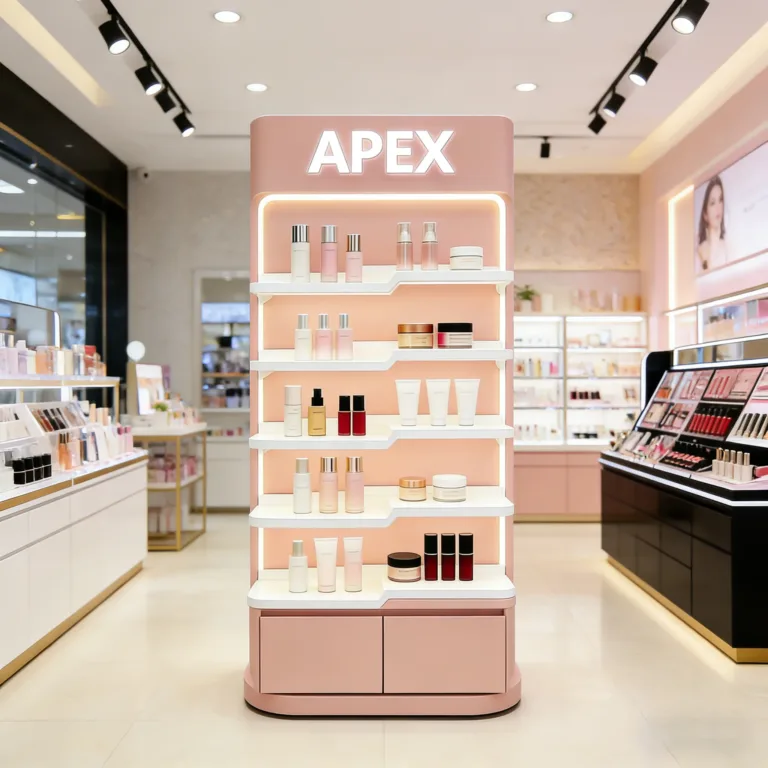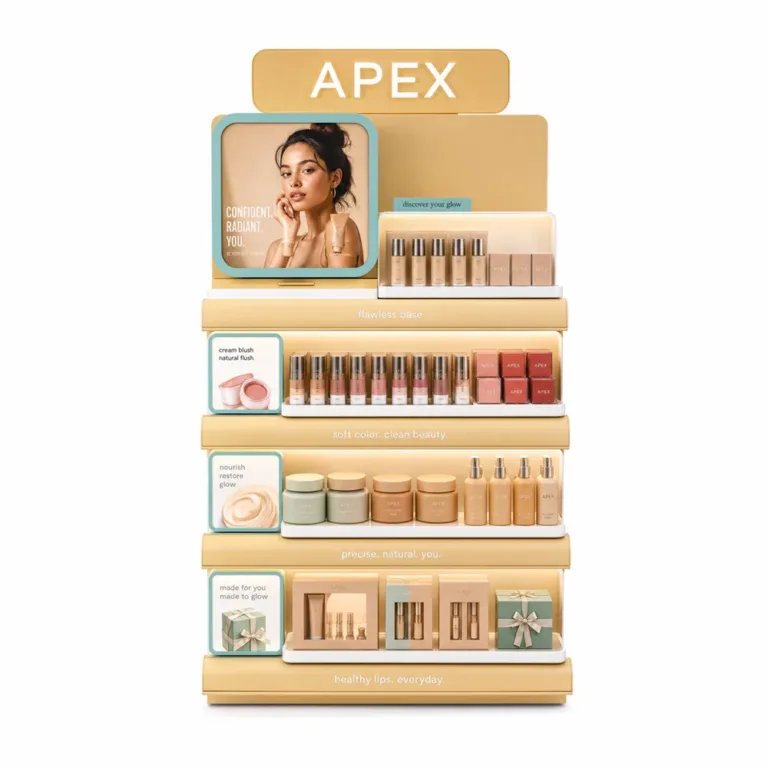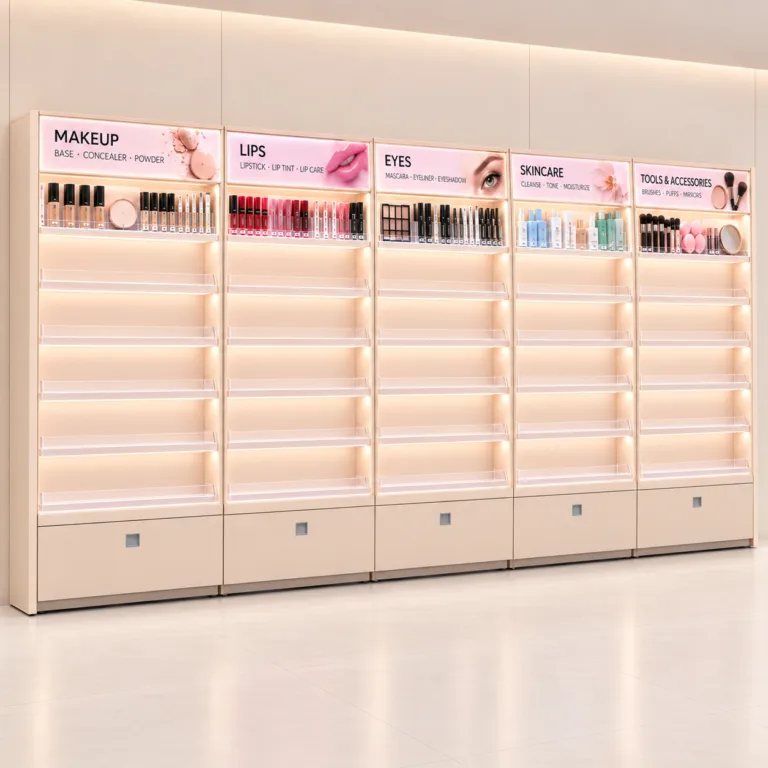
Beauty stores are becoming more dynamic retail environments, where product presentation needs to support both customer experience and business operations.
As brands expand across different locations and product lines change more frequently, retail displays need to do more than hold products.
For cosmetic brands and retail chains, the key challenge is creating display systems that can communicate the brand clearly while remaining practical to deploy, update, and scale. These changing requirements are shaping the next generation of cosmetic retail displays.

Why Are Cosmetic Retail Displays Changing?
Changing Brand Presentation
Beauty brands increasingly need physical stores to express the same identity customers encounter across other channels. Retail fixtures therefore need to work as part of the overall brand environment rather than as isolated product holders.
Expanding Retail Networks
A display designed for one location may eventually need to be reproduced across dozens or hundreds of stores. This makes consistency, production repeatability, installation, and adaptation important considerations during the initial design stage.
Faster Product Changes
New product launches, seasonal campaigns, packaging updates, and changing assortments require displays that can respond without requiring an entirely new store fixture every time.
Trend 1: Custom Display Systems Are Becoming the Standard
Brand Specific Display Design
Generic fixtures can make different brands appear similar within a competitive retail environment. Custom display systems allow brands to define product positioning, visual hierarchy, branding areas, and fixture proportions according to their merchandising strategy.
For brands looking for cosmetic display solutions, available formats can include makeup displays, skincare displays, fragrance displays, endcap units, wall displays, gondola configurations, countertop units, and other merchandising fixtures. The display can be developed around the product range and store environment rather than forcing every project into the same standard format.
Consistent Brand Presentation
For a retail chain, consistency does not mean every store must have an identical layout. The more practical approach is to establish a recognizable structural and visual system that can be adapted to different store formats.
This allows product zones, branding elements, display dimensions, and merchandising configurations to change while maintaining a consistent brand presence.
Scalable Retail Rollouts
A custom display system should also consider what happens after the first store is completed.
Repeatable construction, standardized components, and coordinated manufacturing can make it easier to reproduce the display across multiple locations. This is particularly important for brands entering new retail chains or expanding existing store networks.
Trend 2: Modular Displays Support Faster Retail Changes
Reconfigurable Product Zones
Cosmetic product ranges rarely remain unchanged for long. Modular display systems allow shelves, product holders, graphic elements, and other merchandising components to be adjusted as the assortment develops.
This gives brands more flexibility without requiring the complete fixture to be replaced whenever a product zone changes.
Adaptable Store Formats
A modular system can be configured for different retail environments, including floor displays, wall installations, counters, and other merchandising areas.
The same design language can therefore be applied across different store footprints while allowing the physical configuration to respond to available space.
Easier Campaign Updates
Seasonal launches and promotional campaigns often require changes to graphics, product positioning, or visual communication.
A modular approach makes it possible to update selected components while retaining the main structural system. This can simplify future merchandising changes and reduce unnecessary fixture replacement.
APEX’s recent modular retail display work also emphasizes reconfigurable systems, multi store scalability, integrated lighting, digital modules, and easier deployment.
Trend 3: Integrated Lighting Becomes Part of Display Engineering
Highlighting Priority Products
Lighting can help establish visual hierarchy within a cosmetic display. Brands can use illumination to draw attention to new products, premium collections, hero SKUs, or specific merchandising zones.
The goal is not simply to make a display brighter. Lighting needs to support the way products are organized and viewed.
Integrated Fixture Lighting
Modern retail displays increasingly integrate LED components directly into the fixture structure.
This approach allows lighting to work together with the structural frame, shelves, branding elements, and product positioning. It can also help maintain a cleaner appearance than treating lighting as a separate installation.
Supporting Premium Brand Experiences
For premium beauty environments, lighting contributes to the overall relationship between products, fixtures, and surrounding store design.
APEX’s current retail display engineering approach combines structural systems with integrated lighting and concealed wiring, allowing illumination to become part of the overall fixture design.
Trend 4: Digital Modules Add Interactive Product Experiences
Interactive Product Information
Digital screens can provide product demonstrations, usage information, campaign content, or brand storytelling at the point of interaction.
This gives shoppers access to information that may not be practical to communicate entirely through packaging or printed graphics.
Sensor Based Display Interaction
Interactive functions can connect physical product handling with digital content.
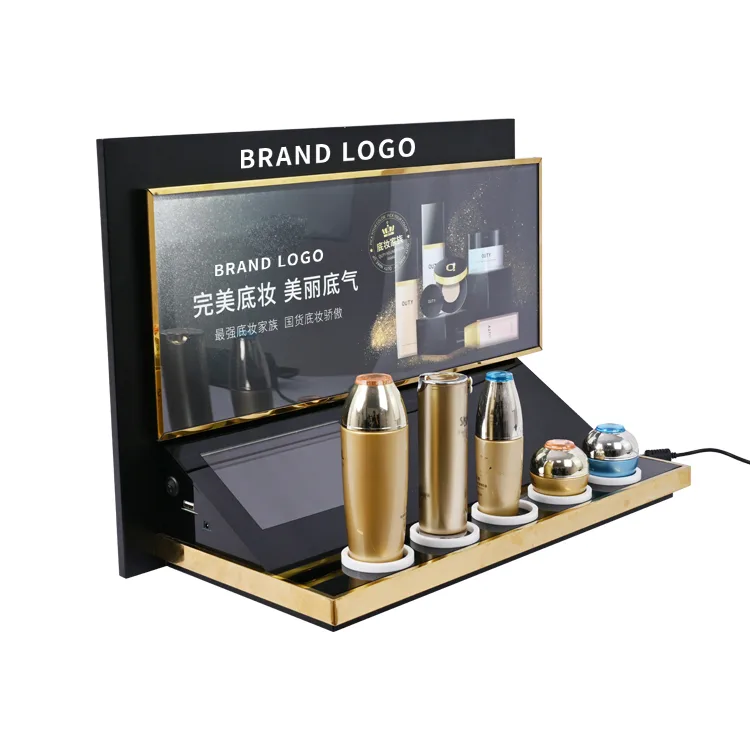
For example, APEX has a cosmetic display featuring a metal structural frame, sensors, and an LCD screen. When a customer picks up a product, the screen can play corresponding video content.
This type of system shows how digital functions can be integrated into a physical merchandising environment without replacing the product display itself.
Integrated Digital Modules
Digital components are most effective when they are considered during the fixture design stage.
Combining digital screens, sensors, lighting, product holders, and structural elements within one system can create a more coordinated customer experience while keeping the display aligned with the brand environment.
Trend 5: Vertical Displays Improve Store Space Utilization
Floor Standing Display Systems
Floor standing fixtures can create dedicated product zones while using vertical space to increase product exposure.
This format is useful for brands that need a stronger presence within a store without relying entirely on large permanent installations.
Wall Mounted Merchandising
Wall mounted systems can turn unused vertical areas into organized merchandising zones.
They are particularly useful for stores where floor space is limited and can help establish dedicated areas for skincare, cosmetics, fragrance, or other product categories.
Compact Countertop Displays
Countertop displays provide another way to introduce selected products within limited areas.
They can be used for product launches, testers, promotional collections, or high priority products near customer interaction points. APEX’s current cosmetic counter display range includes customized solutions for beauty brands, department stores, boutique retailers, and promotional environments.
How Should Brands Choose a Cosmetic Retail Display System?
Match the Display to the Retail Objective
Different retail objectives require different display configurations.
| Retail Objective | Suitable Display Approach | Key Consideration |
| Premium brand presentation | Custom floor or wall display | Brand identity and visual hierarchy |
| Multiple store rollout | Modular display system | Consistency and installation |
| New product launch | Dedicated display or endcap | Product visibility and campaign flexibility |
| Limited store space | Vertical or countertop display | Space utilization |
| Interactive product education | Display with digital module | Customer interaction |
Plan for Future Changes
Brands should consider how frequently product assortments, packaging, graphics, and campaigns are likely to change.
A display designed only around the initial product range may become difficult to maintain later. Modular structures and replaceable merchandising elements provide more flexibility when product requirements change.
Consider the Complete Retail Rollout
For chain retailers, fixture design is only one part of the project. Production consistency, transportation, installation, store compatibility, maintenance, and future updates can all affect the performance of a retail display program.
These requirements should be considered together from the beginning of the project. A full store solutions approach can help coordinate display fixtures and other retail elements as part of one consistent store environment.
Frequently Asked Questions
What Is the Biggest Trend in Cosmetic Retail Display Design?
Customization and modularity are two major trends. Brands increasingly need displays that communicate their identity while remaining flexible enough to support changing products, campaigns, and store environments.
Why Is Modularity Important for Beauty Retail Chains?
Modularity allows selected parts of a display to be adjusted or replaced without rebuilding the entire fixture. This can make future merchandising updates easier across multiple retail locations.
How Does Lighting Improve Cosmetic Retail Displays?
Integrated lighting can improve product visibility and establish visual focus within a display. When designed as part of the fixture structure, lighting can also support a more coordinated retail environment.
Are Digital Modules Suitable for Cosmetic Displays?
Yes. Digital screens and sensor based functions can provide product information, demonstrations, campaign content, and interactive experiences. They can complement physical merchandising without replacing it.
What Should Brands Consider When Ordering Custom Cosmetic Displays?
Brands should consider product requirements, store layout, branding, merchandising objectives, lighting, modularity, installation, production consistency, and future changes. For multi store projects, these factors should be evaluated as one complete display system.
Conclusion
Cosmetic retail displays are moving toward more customized, modular, and technology integrated systems. For brands and retail chains, the priority is no longer simply choosing a display fixture, but developing a system that supports brand presentation, store operations, and future merchandising changes.
If you are planning a customized cosmetic display, multi store rollout, or modular retail system, contact APEX Store Solutions to discuss your project requirements.