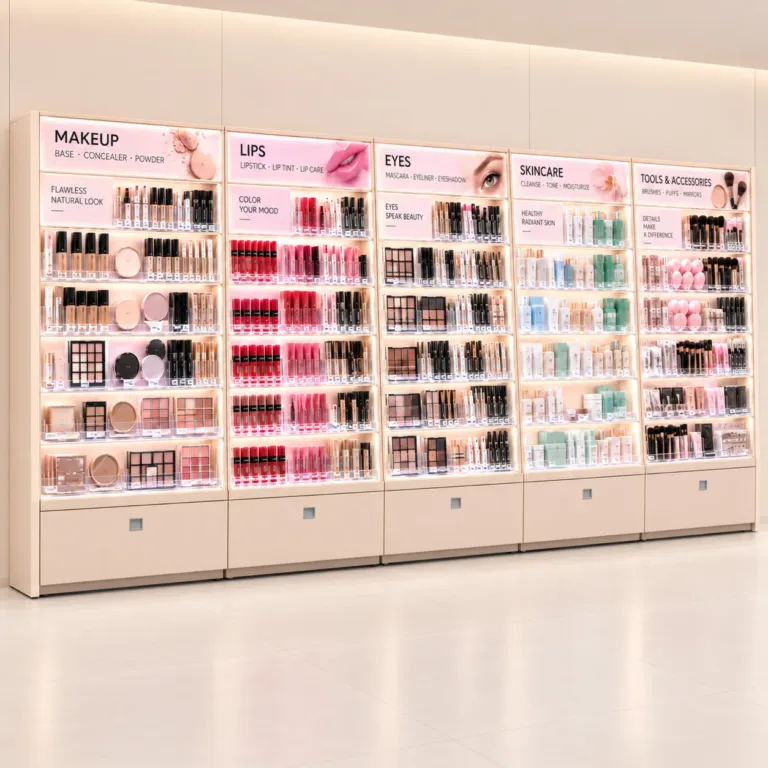
Multi-Material Engineering: Combining Metal, Acrylic, Wood, Glass, and Specialized Manufacturing Processes into One Complete Display Solution
What Is Multi-Material Integration in Cosmetic Display Manufacturing?
Multi-material integration is the process of engineering different materials, manufacturing methods, and functional components into one complete cosmetic display system. APEX combines metal, acrylic, wood, glass, plastic, decorative finishes, and integrated lighting to develop custom beauty retail displays according to each customer’s structural, visual, and merchandising requirements.
A high-end cosmetic display is rarely manufactured from a single material.
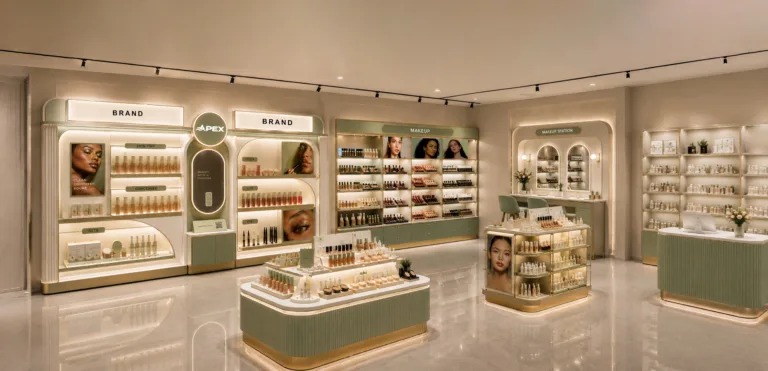
The main framework may be made of metal, while transparent acrylic components hold lipsticks, skincare bottles, or fragrance products. MDF panels provide decorative finishes and storage space, glass components offer transparent protection, and LED lighting highlights merchandise.
Although these components serve different purposes, they must function together as one coordinated structure.
This is where multi-material engineering becomes essential.
The real challenge is not simply producing individual components from different materials. It is ensuring that their dimensions, connections, finishes, and functions work together in the completed display.
At APEX, multi-material integration is part of the product development process, not merely a final assembly task.
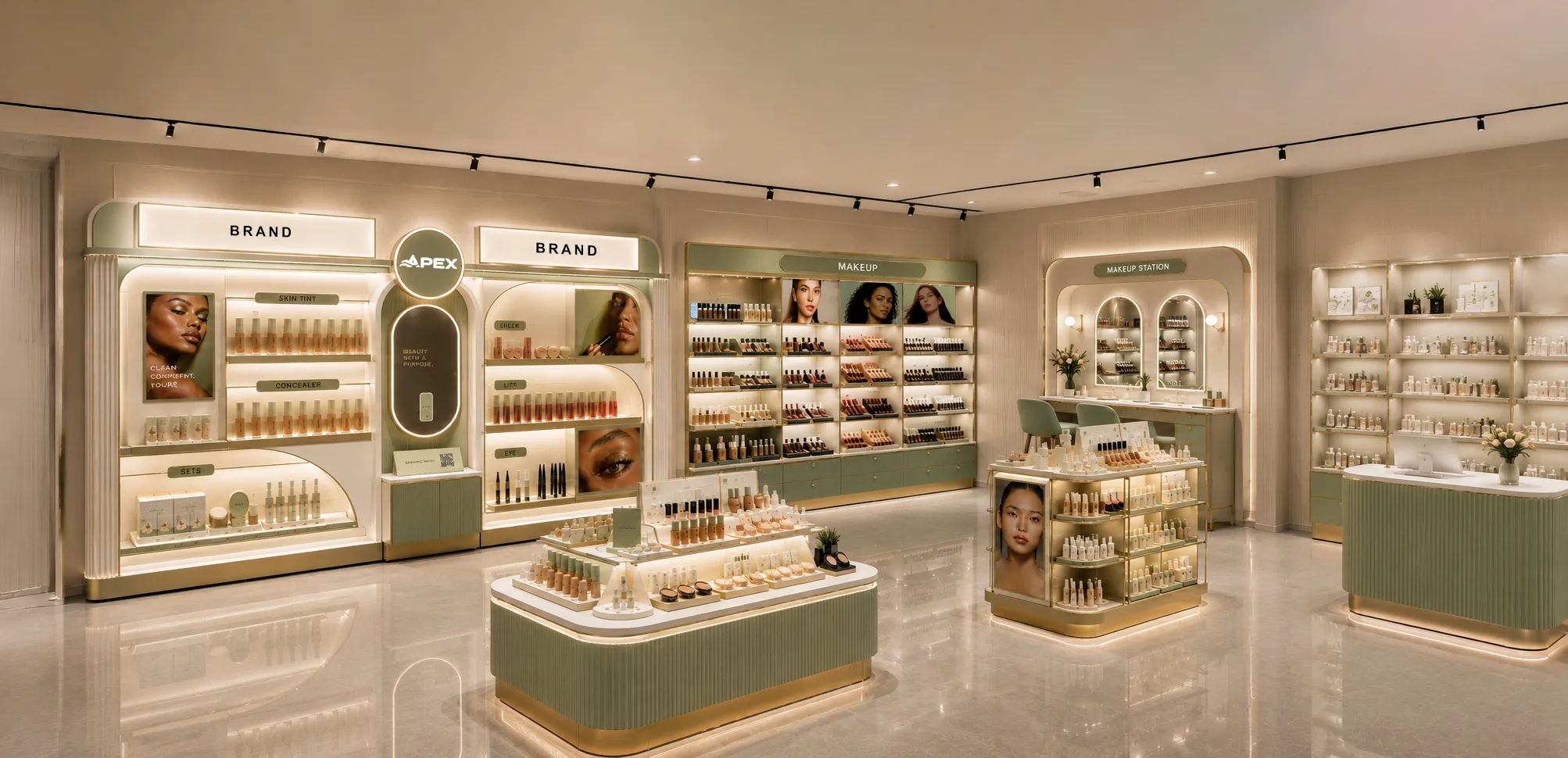
1. Why Do Custom Cosmetic Displays Require Multiple Materials?
Beauty retail environments place demanding requirements on display design.
A cosmetic fixture must present products attractively while accommodating different packaging shapes, tester areas, replenishment requirements, storage space, and brand identity.
No single material is ideally suited to every requirement.
Metal provides structural strength, acrylic offers transparency and precise product positioning, wood contributes visual warmth, and glass supports protective presentation.
Plastic components can be developed for specialized product holders, while integrated lighting creates visual emphasis and improves product visibility.
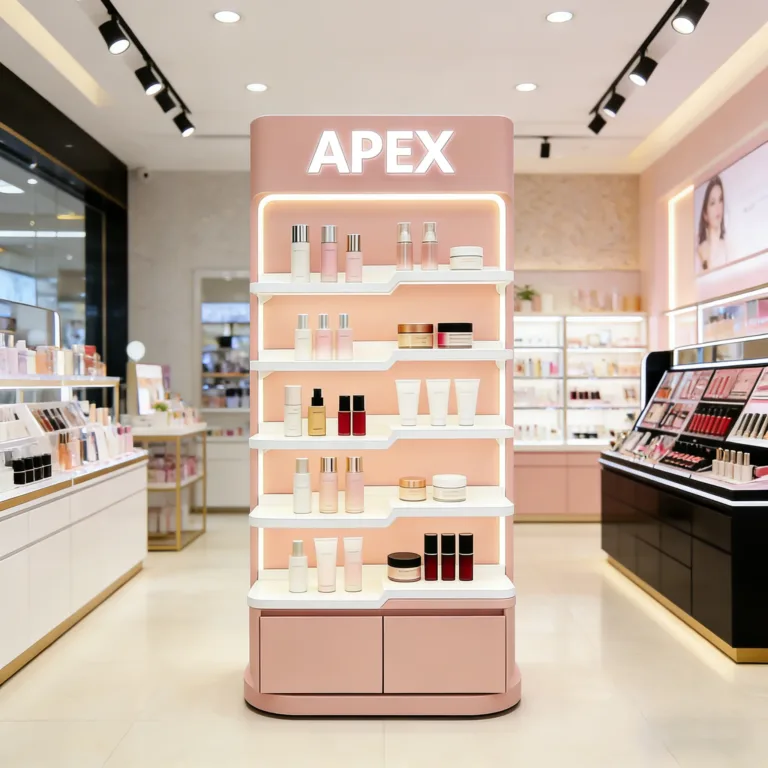
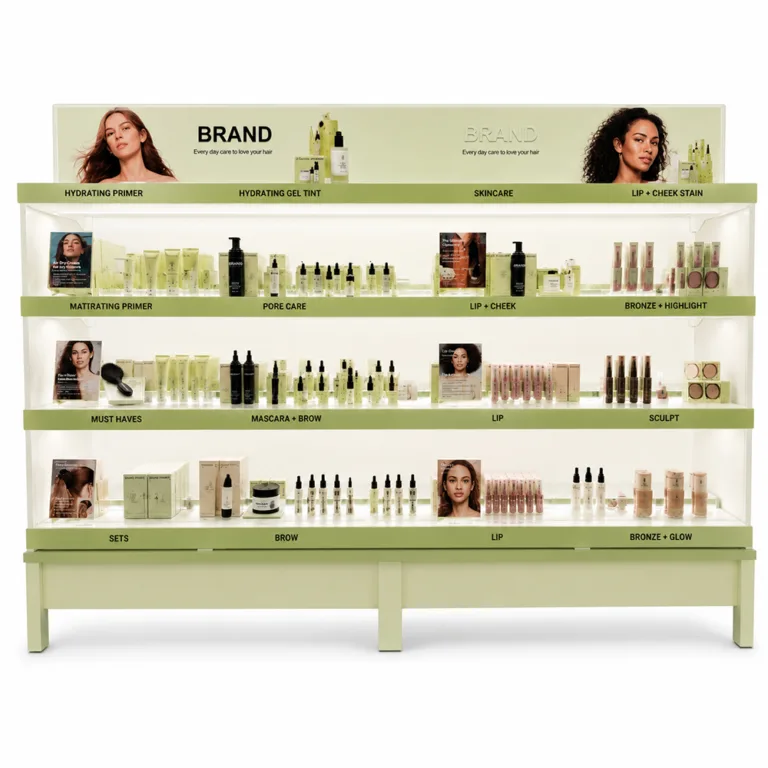
For example, a premium makeup display may combine a metal supporting frame with CNC-machined acrylic lipstick holders, an MDF storage cabinet, decorative branding panels, and concealed LED lighting.
Each material is selected for a particular purpose.
This allows the display to be engineered around the brand’s product characteristics rather than forcing the design to follow the limitations of one material.
2. How Does APEX Select and Combine Materials for Cosmetic Displays?
Material selection begins with the intended function of each component.
| Material | Typical Applications | Primary Engineering Role |
|---|---|---|
| Metal | Frames, brackets, shelving supports | Strength and structural stability |
| Acrylic | Lipstick trays, product holders, dividers | Transparency and precision presentation |
| Wood / MDF | Cabinets, storage, decorative panels | Appearance and functional cabinetry |
| Tempered Glass | Showcase panels and protective doors | Transparent enclosure |
| Plastic | Custom holders, connectors, housings | Specialized shapes and functional components |
| PVC / Graphic Panels | Branding areas and decorative elements | Brand communication |
| LED Lighting | Shelf lighting and illuminated branding | Product visibility and visual emphasis |
The material combination depends on product dimensions, loading requirements, store environment, visual design, maintenance, and budget.
For cosmetic displays, the interaction between these materials is especially important.
A transparent acrylic holder must align with the supporting structure. A decorative panel must fit accurately around its frame. Lighting components must be positioned without interfering with product access or assembly.
Multi-material manufacturing means selecting the right material for each function and engineering every component as part of one complete product.
3. What Are the Main Engineering Challenges of Multi-Material Integration?
Dimensional Accuracy and Material Compatibility
Different materials behave differently during machining, assembly, and daily use.
Metal, acrylic, wood, and glass have different dimensional tolerances, mechanical properties, and responses to temperature or moisture.
When these differences are not considered, finished displays may develop visible gaps, misaligned components, assembly difficulties, or localized stress.
For example, installing an acrylic tray inside a metal supporting frame requires accurate positioning and suitable clearance.
The connection must hold the tray securely without applying unnecessary pressure to the acrylic.
APEX considers component dimensions, suitable connections, and manufacturing feasibility during engineering development to support consistent assembly.
Structural Connections Between Different Materials
A multi-material display may require several joining methods.
Metal frameworks can use welding or mechanical fasteners. Acrylic components may require precision bonding or mechanical connections. Wooden panels and glass elements need suitable mounting structures.
These connections affect more than structural strength.
They can also influence the appearance, installation process, maintenance, and ease of replacing individual components.
For premium cosmetic displays, exposed screws, visible adhesive lines, or poorly aligned connections can reduce the intended visual quality.
Therefore, joining methods should be considered during structural development rather than selected only at the final assembly stage.
Surface Finishing and Brand Color Consistency
Beauty brands often require strict visual consistency across their retail fixtures.
A display may combine powder-coated metal, colored acrylic, decorative wood panels, printed graphics, and illuminated branding.
Even when similar color references are used, different materials can produce different appearances because of surface texture, gloss, transparency, and lighting conditions.
APEX coordinates material samples, finishing specifications, printing methods, and prototype evaluation to help achieve a consistent overall design.
For applicable components, processes may include powder coating, polishing, silk-screen printing, UV printing, and decorative transfer techniques.
The goal is to create a unified brand presentation rather than a fixture that looks like a collection of unrelated materials.
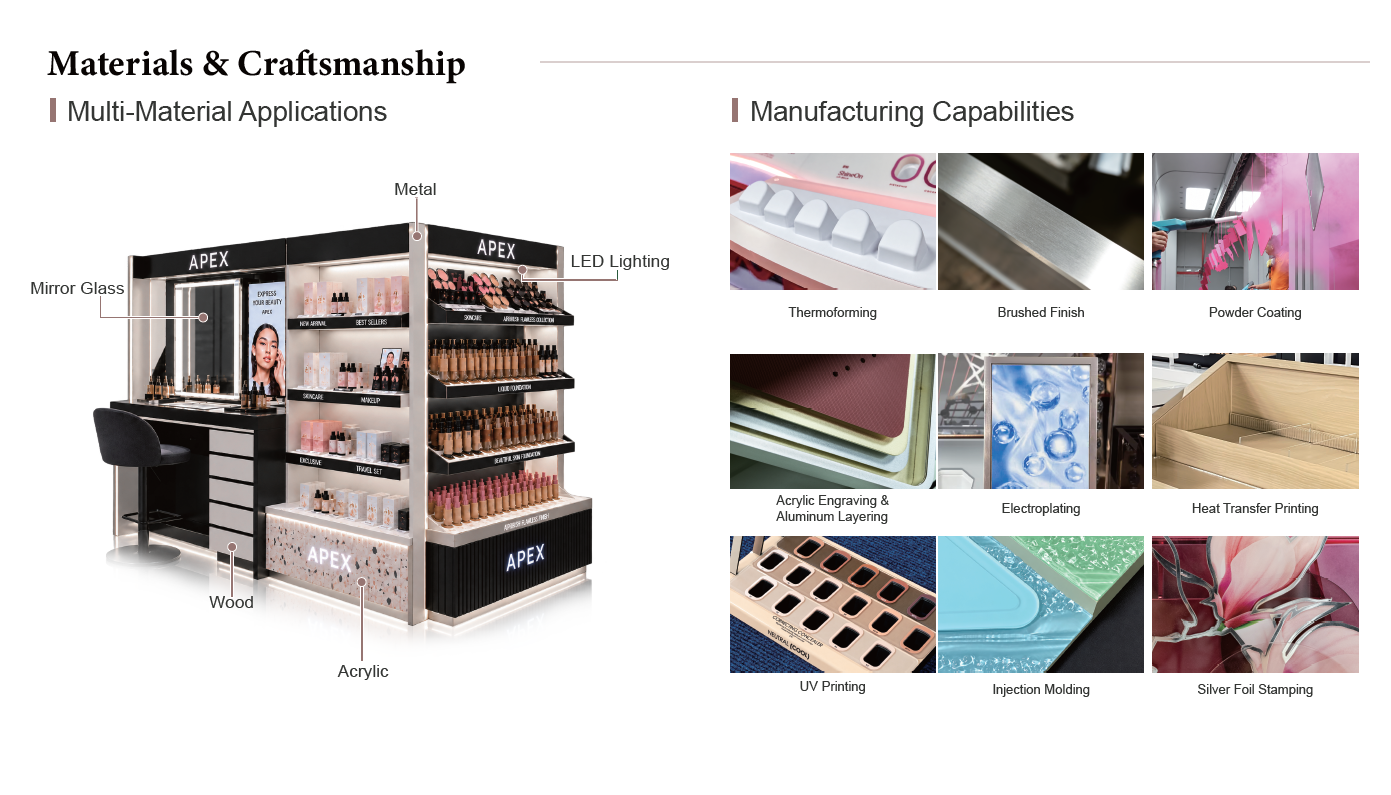
4. How Are Special Manufacturing Processes Used in Multi-Material Cosmetic Displays?
A custom cosmetic display may require several manufacturing processes to produce different components.
Precision CNC Machining for Product-Specific Holders
Cosmetic packaging is available in many shapes and sizes.
Lipsticks, foundation bottles, nail polish, perfume bottles, and skincare containers often require different positioning structures.
CNC machining can be used to develop customized slots, recesses, holes, and component profiles according to product dimensions.
This allows product holders to be designed around the actual packaging rather than using generic arrangements.
Acrylic Heat Bending, Bonding, and Polishing
Acrylic components can be processed using cutting, heat bending, precision bonding, grinding, and polishing.
Heat bending supports curved or specially shaped structures.
Precision bonding allows multiple acrylic components to form a complete presentation unit.
Suitable edge finishing can improve the transparency and appearance of visible surfaces.
These techniques are particularly valuable for high-end cosmetic counters where transparent components and refined details are prominent.
Metal Fabrication and Decorative Finishing
Metal components may require cutting, bending, welding, machining, and surface treatment.
Depending on the intended visual style, different finishes can be selected for the frame, trim, supports, and other metal components.
The metal structure must also accommodate the installation of acrylic, glass, wooden panels, and lighting.
Customized Plastic Components and Tooling
Some cosmetic products require special holders or connecting components that cannot be achieved using standard parts.
Depending on the design and order quantity, customized plastic components may be developed through suitable fabrication or molding methods.
New molds are not necessary for every project.
APEX evaluates the component geometry, material, expected quantity, and manufacturing method before recommending a tooling approach.
5. How Does APEX Integrate Lighting and Functional Components with Different Materials?
Integrated lighting is one of the areas where multi-material coordination becomes especially important.
A cosmetic display may feature LED lighting beneath shelves, within decorative panels, around product presentation areas, or inside illuminated branding elements.
These lighting elements must be coordinated with the physical structure.
For example, a metal shelf may incorporate a lighting channel, while a wooden cabinet provides space for concealed wiring and electrical components.
Transparent acrylic elements may be positioned to support the intended illumination effect without obstructing product access.
Depending on the project, APEX can also develop display structures incorporating adjustable shelving, removable product holders, pushers, drawers, locking systems, and interactive components.
Such functions should be considered during design and engineering.
The purpose of functional integration is not to add as many features as possible, but to make every material and component work together according to the customer’s actual retail requirements.
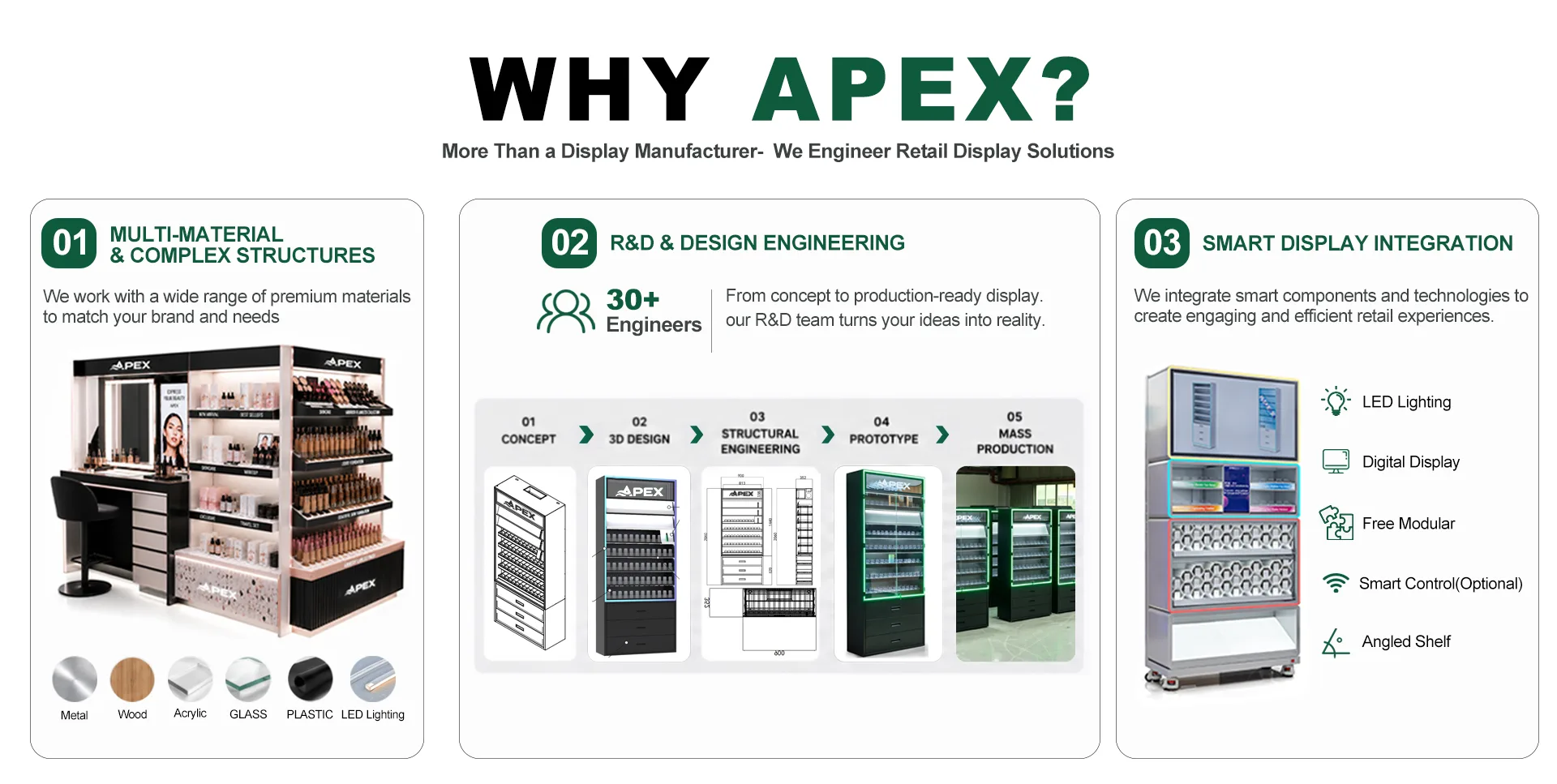
6. How Does APEX Coordinate Multi-Material Manufacturing?
A complex custom cosmetic display may involve several processing technologies and specialized production stages.
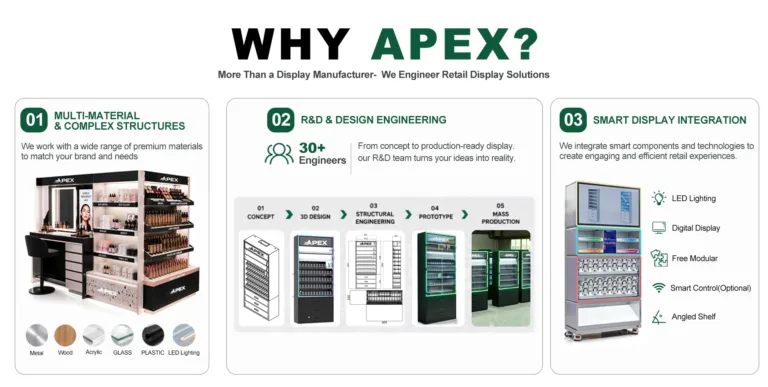
APEX combines its manufacturing capabilities with coordinated specialist production resources to develop and manufacture mixed-material display fixtures.
The development process begins with customer requirements, including drawings, product dimensions, appearance references, intended functions, and expected order quantities.
Design and Engineering Evaluation
The structure is reviewed to determine which materials are appropriate for each component.
Connection methods, assembly requirements, surface finishes, and manufacturing feasibility are considered before production.
Material and Process Coordination
Metal, acrylic, wood, plastic, and other components are manufactured using the processes suited to their specifications.
Different production stages are coordinated to support component compatibility and the intended finished appearance.
Prototyping and Assembly Verification
A prototype provides an opportunity to evaluate component fit, visual consistency, product compatibility, structural stability, and functional integration.
Adjustments can be made before the design is approved for production.
Manufacturing and Quality Control
Once specifications are confirmed, component production, finishing, assembly, and inspection are coordinated according to the agreed requirements.
For repeat orders, approved material specifications, structural details, and assembly methods provide a basis for manufacturing consistency.
Packaging and International Delivery
Multi-material products often require different protection methods for metal, acrylic, glass, and decorative surfaces.
Packaging and assembly requirements are considered to support transportation and installation at the destination.
This coordinated approach helps customers manage complex manufacturing requirements through a unified development process.
7. Why Should Beauty Brands Choose a Manufacturer with Multi-Material Engineering Capabilities?
For beauty brands, retail chains, and design agencies, the value of multi-material manufacturing extends beyond appearance.
Greater Design Freedom
Different materials and processes can be selected to support original display concepts rather than relying on standard product templates.
More Precise Product Presentation
Custom holders, trays, and structural components can be designed around specific packaging sizes and merchandising requirements.
Coordinated Visual Identity
Different materials, finishes, graphics, and lighting can be developed together to create a consistent retail presentation.
Manufacturing Feasibility
Material selection, structural connections, assembly methods, and processing requirements can be evaluated before full production.
Support for Repeat Retail Programs
Once a display design has been developed and approved, defined material and manufacturing specifications can support repeat production and future retail programs.
8.Frequently Asked Questions
Can APEX combine metal, acrylic, wood, and glass in one cosmetic display?
Yes. APEX can develop mixed-material cosmetic display systems according to customer requirements. The structure, component connections, material compatibility, and assembly methods are evaluated during development.
How does APEX maintain consistency between different material finishes?
The process involves reviewing material samples, color references, surface textures, finishing methods, and prototypes. Final appearance requirements should be confirmed through approved samples.
Can APEX manufacture special lipstick holders or cosmetic product trays?
Yes. Product holders and trays can be developed according to the size and shape of the merchandise, using suitable materials and processes such as CNC machining, acrylic forming, or custom tooling when required.
Is multi-material manufacturing more expensive than using one material?
Not necessarily. The cost depends on the structure, selected materials, finishing requirements, production quantity, and assembly complexity. Using different materials for different functions can sometimes offer a more practical balance between appearance, performance, and cost.
Can integrated LED lighting be customized for different display structures?
Yes. Lighting configurations can be evaluated according to the shelf layout, cabinet structure, product presentation requirements, electrical installation, and maintenance needs.
Can APEX manufacture cosmetic displays from an original design?
Yes. APEX supports OEM and ODM display projects, including material evaluation, structural engineering, prototyping, manufacturing coordination, and production according to approved specifications.
Conclusion: Multi-Material Integration Is the Foundation of Advanced Custom Cosmetic Displays
Multi-material manufacturing is not simply about using metal, acrylic, wood, glass, or plastic in the same product.
It is about understanding how different materials behave, how components connect, and how manufacturing processes must work together to achieve the intended design.
At APEX, we combine structural engineering, material selection, precision processing, surface finishing, functional integration, and manufacturing coordination to support customized cosmetic display development.
This approach allows beauty brands to create display fixtures based on their own products, visual identity, and retail requirements rather than the limitations of standard templates.
Different Materials. One Coordinated Design. One Complete Display Solution.
Have a cosmetic display concept that requires multiple materials or specialized manufacturing processes?
Share your drawings, reference images, product dimensions, or design requirements with APEX.
Contact APEX to Develop Your Custom Multi-Material Cosmetic Display.